Ph.D. Progress Report
Designing for
the Unspoken
Tacit Knowledge Externalization for
Human–GenAI
Collaboration
Iren Irbe
May 2026
Framework + Implementation
EASCI governance instantiated in TacitFlow: voice capture, GraphRAG, provenance, and bounded AI
(Experience–Articulation–Structuring–Consolidation–Innovation)
Problem 1: Tacit Knowledge Is Difficult to Capture and Transfer
During onboarding and offboarding, organizations struggle to retain and pass on employees’ unspoken, experience-based knowledge because it is rarely written down and hard to share.
Research Aim
To develop and evaluate a theoretical and technological approach for capturing, externalizing, and transferring tacit knowledge in high-stress public-sector environments.
The research investigates how a voice-controlled, GraphRAG-powered assistant can help preserve and reuse this hidden expertise through natural interaction and contextual learning support.
Tacit Knowledge
Michael Polanyi (1966) defined tacit knowledge as understanding that is "inherently difficult to articulate," summarized in his aphorism:
"We can know more than we can tell."
It encompasses know-how, mental models, and intuitions gained through action and experience.
The Transfer Challenge
Von Hippel (1994) coined the term "sticky information" to describe knowledge that is costly to transfer because it is context-dependent.
Tacit knowledge demonstrates this stickiness: its transfer relies on social interaction, observation, and shared experience rather than documentation.
Problem 2: Operational Pressures Prevent Tacit Knowledge Transfer
Data volume has overwhelmed traditional mentorship models.
The Big Data Reality
Agencies process over 10,000 hours of video every day.
80% of evidence is unstructured data (Europol, 2024).
The Human Consequence
Senior analysts spend 90% of their time on routine data processing.
The "Master-Apprentice" model requires time that no longer exists.
The Cognitive Bottleneck
Analysts’ valuable intuition gets buried under routine data work. Without AI to handle the repetitive tasks, there’s no time left for the human interaction needed to transfer tacit knowledge.
Situated Learning
Brown, Collins & Duguid (1989) established that knowledge is inseparable from the activity, context, and culture in which it develops.
The "Master-Apprentice" model depends on legitimate peripheral participation: novices learn by working alongside experts in authentic contexts.
Information Overload
Miller (1956) established that human working memory can hold approximately 7±2 items simultaneously.
When data volume exceeds this capacity, processing degrades. Modern intelligence environments routinely exceed these limits, creating the "cognitive bottleneck."
Presenter Notes
- Start with the sheer volume: 10k hours/day is unmanageable manually.
- Highlight the 10x growth in case data size (100GB to 1TB).
- Connect this to the "death of mentorship": seniors are too busy processing data to teach juniors.
- Use Miller's law to explain why this breaks the human brain (cognitive overload).
- Conclude with the bottleneck: AI is needed not just for speed, but to free up human capacity for tacit transfer.
Problem 3: Institutional Knowledge Disappears Faster Than It Can Be Replaced
The "Silver Tsunami" creates a knowledge vacuum that money cannot fill.
The Experience Gap
It takes 5–7 years of field experience to rebuild operational competence.
The Tangible Cost
6–8× Annual Salary
Direct training, recruitment, reduced productivity during ramp-up, supervision burden, and error costs.
The Intangible Cost
"Deep Smarts"
Unwritten heuristics, informant networks, and pattern recognition that are never documented in SOPs.
Why "Writing It Down" Is Insufficient
The Curse of Knowledge (Hinds, 1999): Experts systematically underestimate how difficult tasks are for novices because they cannot "un-know" what they have learned. They often fail to articulate the critical "why" behind their decisions because it feels obvious to them.
Deep Smarts (Leonard, 2005)
Expert intuition built through years of experience: pattern recognition, judgment under uncertainty, and contextual awareness.
Unlike explicit knowledge in manuals, deep smarts are transferred through guided experience and Socratic dialogue.
Inheritance Imperative
Hang & Zhang (2024) argue that when experts retire, organizations face a "knowledge inheritance crisis."
Departing expert knowledge is organizational inheritance that must be actively claimed through structured protocols.
Recognition-Primed Decision
Klein (1993) showed that experts do not deliberate options; they recognize patterns.
TacitFlow preserves these pattern libraries by capturing the cues experts notice.
Workforce Crisis
- OECD (2025): 40% of civil servants report burnout; 13% intend to leave within 12 months.
- Europol (2025): Urgent need for "state-of-the-art analytical competence" to address capability gaps.
Presenter Notes
- Hook: The "Silver Tsunami" isn't just about empty desks; it's about empty minds.
- Visual: Point to the gap. 20 years vs 2 months. That gap is where mistakes happen.
- Theory: Briefly mention "Deep Smarts" - it's not magic, it's pattern recognition (Klein).
- Problem: Explain "Curse of Knowledge" - experts can't teach this easily because they've forgotten what it's like not to know.
- Solution Tease: A system is needed that extracts this "obvious" knowledge before they leave.
Problem 4: Ungoverned GenAI Cannot Be Used to Solve These Challenges
The issue is not whether AI is powerful enough; it is whether its outputs can become accountable knowledge.
Standard assistants behave like oracles: fluent, fast, and often persuasive, but weak at preserving who reasoned, what alternatives were considered, and who validated the result.
1. Sovereignty & Evidential Boundaries
High-risk public-sector work often requires controlled infrastructure, clear separation between factual data and personal assessments, and auditable handling of sensitive case material.
2. Persuasive Opacity
GenAI can convert weak or unvalidated material into authoritative prose. EASCI treats every AI contribution as candidate scaffolding, not as evidence or validated knowledge.
3. The Process Gap
Model-level explanations do not answer the lifecycle questions: who articulated the claim, what counter-hypotheses were considered, who reviewed it, and when it must be revised or retired.
"The solution requires LLMs as bounded collaborators, with human authorship, peer validation, and process-level explainability built into the workflow."
The newer EASCI constraint is stricter than “cite your sources”: AI suggestions do not persist unless a practitioner explicitly accepts them.
Before peer review, every provisional Knowledge Object must record at least one alternative explanation and the practitioner's disposition toward it.
PROV-O records do more than cite documents: they trace provenance, rationale, peer review, reuse boundaries, and evolution across the artifact lifecycle.
- Frame the risk as governance failure, not simply “AI hallucination.”
- Emphasize the five non-negotiable AI constraints: no authorship, no validation, no dissent suppression, no autonomous retirement, reject-by-default.
- Connect the slide to EU AI Act oversight and LED logging requirements without claiming the system automates legal decisions.
- Explain why process traces matter: reviewers need a record of reasoning, not just an answer.
Research Outputs
A 2026 research corpus connecting theory, cognitive ergonomics, AI & Law, and machine-checked governance.
| Track | Artifact | Title / Context |
|---|---|---|
| Framework | Theory Paper | "From SECI to EASCI: Operationalizing Tacit Knowledge Externalization for Human–GenAI Collaboration in High-Stress Contexts" |
| Cognitive | ECCE Paper | "Externalization by Design: Cognitive Load, Bounded AI, and Process-Level Accountability in Expert Knowledge Systems" |
| AI & Law | Demo Paper | "From Oracle to Sparring Partner: Devil's Advocate for AI-Supported Hypothesis Stress-Testing in Legal Investigations" |
| Formal | Lean 4 Report | "EASCI Framework: Machine-Checked Formalization in Lean 4" (proof debt explicitly tracked; no overclaim of zero escape hatches) |
| Empirical | Design Science Basis | Scoping review of 55 sources, practitioner interviews (N=10), and participatory workshops informing TacitFlow Field and Workbench. |
| Prototype | Software Hypothesis | TacitFlow Field + TacitFlow Workbench: dual-interface instantiation of the EASCI lifecycle with GraphRAG, PROV-O, counter-hypothesis stress testing, and human validation gates. |
The research now reads as a corpus: EASCI supplies the framework, ECCE supplies the cognitive-load and governance argument, ICAIL supplies the Devil's Advocate demonstration, and Lean supplies machine-checked structural assurance.
The four manuscripts deliberately address different review communities: knowledge management, cognitive ergonomics, AI & Law, and formal methods.
- This slide establishes academic rigor.
- Highlight the progression: empirical gap -> EASCI architecture -> TacitFlow instantiation -> formal verification.
- Separate theoretical contribution from empirical status: quantitative validation is planned, not yet claimed.
- Name the four source documents so the committee sees a coherent publication strategy.
Research Questions
The questions now separate empirical grounding, framework design, prototype instantiation, and validation.
What current methods are used to capture and transfer tacit knowledge?
Method: Scoping Review
What are the primary barriers and enablers that affect tacit knowledge sharing practices?
Method: Interview Study
How should SECI's underspecified externalization phase be operationalized for high-stress, AI-mediated knowledge work?
Method: Design Science Synthesis
How can TacitFlow instantiate EASCI while preserving human authorship, peer validation, provenance, and lifecycle governance?
Method: Software as Hypothesis + Formalization
Current Focus* Evaluation now focuses on workload, artifact quality, reviewability, and proof obligations rather than broad deployment success.
This study employs Design-Based Research (DBR), iterating between theory and practice to develop a working artifact. DBR bridges the gap between laboratory findings and real-world practice. (Wang & Hannafin, 2005)
RQ4 is an "emergent" question. In DBR, the intervention itself (TacitFlow) acts as a hypothesis. The study tests if the existence of such a tool changes the nature of the problem.
- RQ1 & RQ3 are theoretical foundations (the "What" and "Where").
- RQ2 is the empirical validation (the "Why not").
- RQ4 is the constructive contribution (the "How").
- Emphasize that RQ4 is not just about building software, but using software to probe the theoretical limits of tacit knowledge transfer.
Research Flow
From literature to prototype: a Design-Based Research trajectory.
Scoping Review
Analyzed 55 papers on tacit knowledge transfer and workplace learning to establish the theoretical baseline.
Interviews & Analysis
Conducted semi-structured interviews with 10 experts from high-stress public institutions to validate the problem space.
Key Findings
Identified that informal sharing is critical but fragile, often lost due to turnover and lack of structured capture mechanisms.
Early Prototype (TacitFlow)
Developed a voice-based AI assistant as a "Research Through Design" artifact to probe the feasibility of capture.
Next Steps
Co-design, evaluation, and testing through participatory design sessions with end-users.
Artifacts embody theoretical propositions. The prototype becomes a vehicle for testing ideas rather than merely an end product. (Zimmerman, Forlizzi & Evenson, 2007)
Building systems specifically to validate theoretical constructs. TacitFlow is not a commercial product but a research instrument for testing the EASCI framework. (Leinonen et al., 2008)
- Walk through the timeline chronologically.
- Highlight that the project is currently at Step 4 (Prototype).
- Use the side notes to defend the "building software" part of a PhD. It's a methodological choice, not just engineering.
Scoping Review
Understanding how tacit knowledge is captured and transferred in organizations
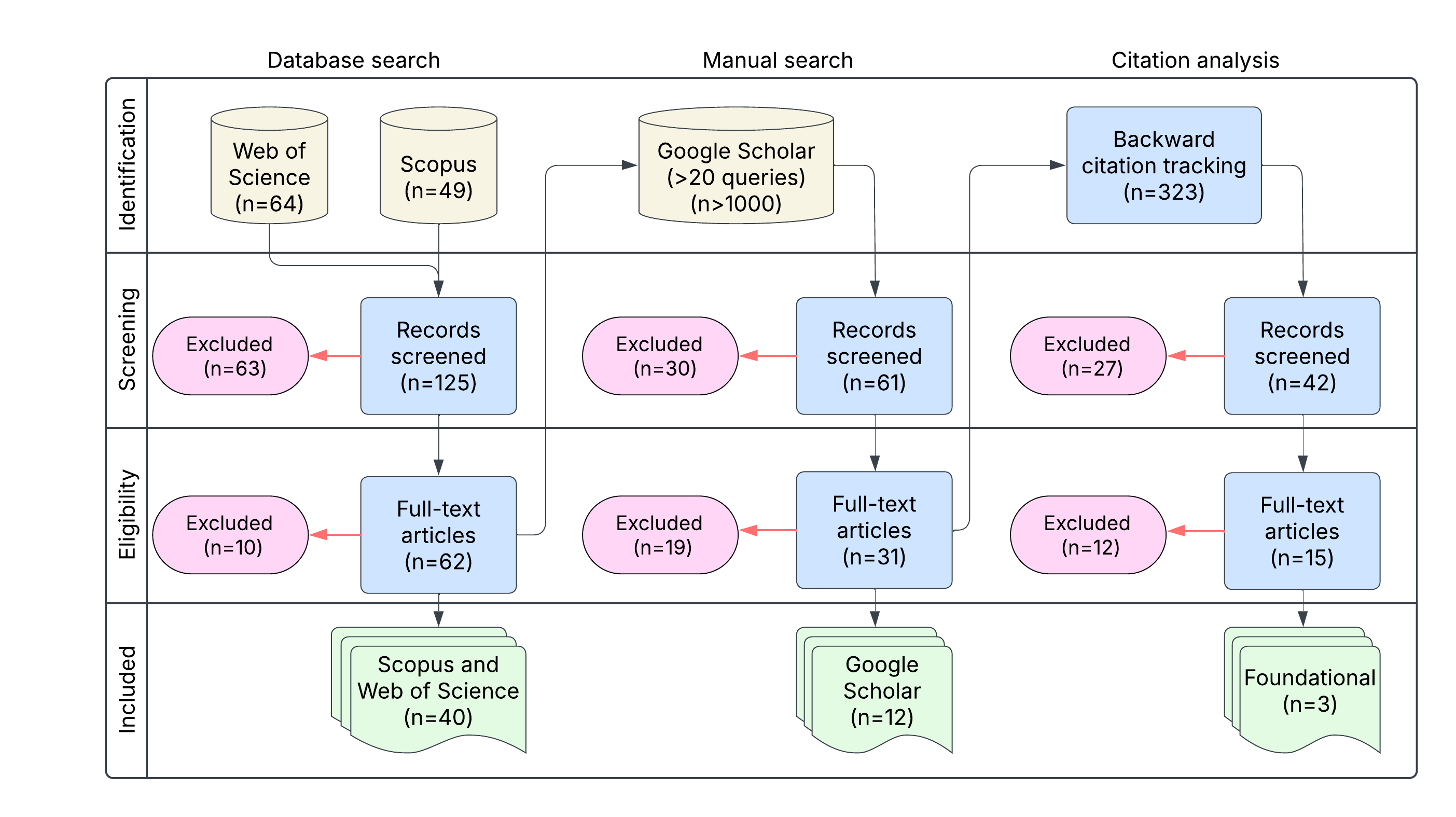
This review examined methods, barriers, and enablers for organizational experience-sharing, with particular attention to transitions (onboarding/offboarding) in complex institutional settings.
| Parameter | Description |
|---|---|
| Corpus | 55 peer-reviewed studies + monographs (2019–2024) |
| Framework | Arksey & O'Malley (2005); PRISMA-ScR |
| Databases | Scopus, Web of Science, Google Scholar |
| Keywords | tacit knowledge · onboarding · offboarding · informal learning · public sector |
| Exclusion | Formal training & general KM systems only |
Methodology
Arksey & O'Malley (2005) established the framework for scoping reviews, distinguishing them from systematic reviews by their broader exploratory purpose. Scoping reviews map key concepts, evidence types, and research gaps rather than synthesizing effect sizes.
PRISMA-ScR
Tricco et al. (2018) extended PRISMA reporting guidelines specifically for scoping reviews, adding items on rationale for review type selection and deviation from protocol. This enhances transparency and reproducibility in exploratory evidence synthesis.
Presenter Notes
- Emphasize the rigor: 55 studies selected from a much larger pool.
- Highlight the specific focus on "transitions" (onboarding/offboarding) as critical moments for tacit knowledge loss.
- Explain the exclusion of "formal training" - the focus is on the unspoken and informal aspects of knowledge transfer.
- The PRISMA flow diagram (right) visually demonstrates the filtering process.
Key Findings from Scoping Review
Barriers, Enablers, and the Human-Centric Reality
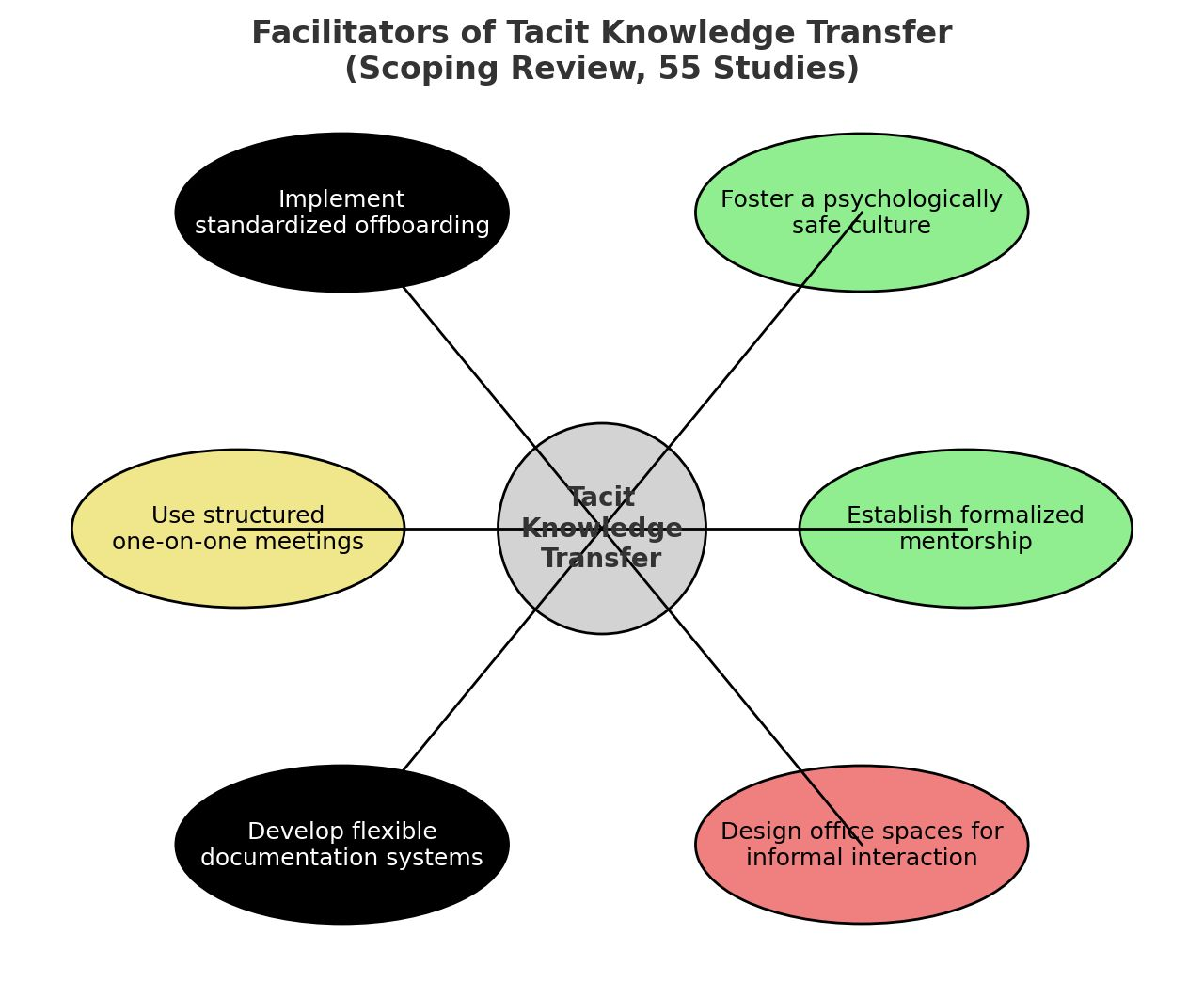
Tacit knowledge transfer remains a deeply human-centered process. The most significant barriers are organizational, not technical. A gap exists at the "Externalization" stage; technology plays only a supplementary role.
Barriers vs. Enablers
Barriers
- •Lack of trust between colleagues
- •Limited time for knowledge sharing
- •Weak knowledge-sharing culture
- •No clear structure for transfer
Enablers
- •Strong interpersonal relationships
- •Open organizational culture
- •Supportive leadership
- •Psychological safety
The Externalization Gap
The SECI model assumes externalization is straightforward. The review found the opposite: converting tacit knowledge to explicit form is the primary bottleneck in knowledge transfer.
Key Insight
A gap exists between how people share knowledge in practice (socially) and how technology supports it (structurally).
Detailed Findings
Most workplaces rely on mentoring, storytelling, and job shadowing. AI or digital tools for experience sharing remain rare. While socialization methods are common, they rarely succeed in making tacit knowledge explicit.
Presenter Notes
- Discuss the "Externalization Gap" - this is where TacitFlow aims to intervene.
- Note the color coding: Green (Social) factors are enablers, while Gray/Yellow (Org/Structural) are often barriers.
- The diagram (Figure 3) synthesizes these factors into a holistic view of the transfer environment.
Interview-Based Empirical Study
Knowledge sharing in high-stress public sector organizations
| Dimension | Details |
|---|---|
| Goal | Explore real onboarding/offboarding practices in high-stress public institutions. |
| Participants | 10 professionals (6 managers, 4 specialists) across 6 Estonian organizations. |
| Approach | Semi-structured interviews (45-90 min) + Thematic Analysis. |
| Coding | Hybrid deductive-inductive approach (Braun & Clarke, 2006). |
"Knowledge transfer in organizations usually relies on informal and unstructured practices, such as spontaneous (ad hoc) mentoring or casual peer-to-peer storytelling."
Key Empirical Finding
Organizations rely heavily on informal practices because formal systems fail to capture experience-based judgment. Barriers include lack of psychological safety, isolated workspaces, outdated documentation, and missing offboarding procedures. These are precisely the gaps EASCI addresses.
Thematic Analysis
Braun & Clarke (2006) established thematic analysis as a qualitative method. Their six-phase process (familiarization, coding, theme generation, review, definition, write-up) enables systematic pattern identification while remaining accessible. Unlike grounded theory, it permits both inductive and deductive coding.
From Interviews to EASCI
This study revealed that tacit-to-explicit conversion does not happen in one leap (as SECI suggests). Interview data showed knowledge transfer requires multiple deliberate stages: initial recognition of experience, tentative articulation, structured formalization, social validation, and adaptive refinement.
Participating Organizations
- EASS: Estonian Academy of Security Sciences
- KRA: Defence Resources Agency
- MoD: Ministry of Defence
- PBGB: Police & Border Guard Board
- RIA: Information System Authority
- SMIT: IT & Development Centre
Presenter Notes
- Interviews were conducted with 10 professionals from high-stress environments (Police, Defense, IT).
- Used Braun & Clarke's thematic analysis to identify patterns.
- Crucial Insight: The "leap" from tacit to explicit is too big for a single step. It requires a staged approach.
- This empirical evidence directly informed the 5-stage EASCI framework discussed next.
Interview Findings
Tacit knowledge in Estonian public sector organizations
When experienced personnel depart, they take "sticky" tacit knowledge with them. This knowledge is embedded in intuition, informal routines, and "gut feelings" rarely captured in formal manuals.
Key Observations
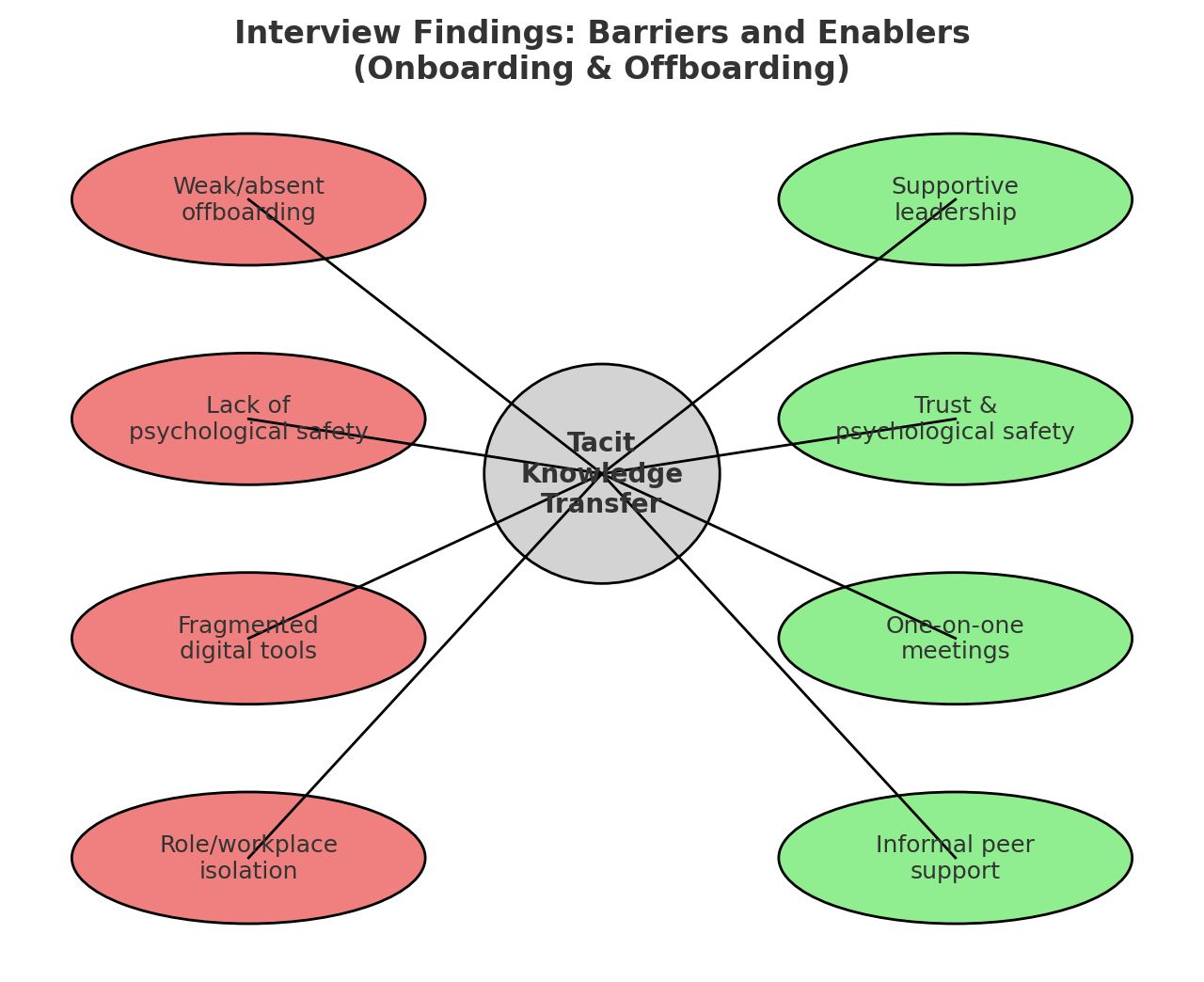
- Informal Sharing Relies on mentoring, teamwork, and social interaction.
- Weak Capture Experience stays in heads; systematic capture is rare.
- Barriers Stress, time pressure, lack of structure & safe spaces.
- Enablers Trust, open culture, and psychological safety.
- Offboarding Often unplanned, unstructured, and rushed.
"Sticky" Tacit Knowledge
Von Hippel (1994) coined "sticky information" to describe knowledge costly to transfer. Tacit knowledge is deeply embedded in context, making it resistant to codification.
Current Mechanisms
Transfer relies on ad-hoc mentoring ("watch me do this"). This breaks down during rapid turnover or when key personnel leave unexpectedly.
Practitioner Interest
Participants expressed strong preference for tools making sharing easier. Voice-based AI assistants resonated well for quick, natural capture.
Presenter Notes
- Define "Sticky Knowledge" - it costs money and time to move it.
- Point out the red bars in the list: Barriers and Offboarding are major pain points.
- The diagram shows the environment where this happens.
- Mention the "Voice AI" finding - this validates the technical approach later.
The Externalization Gap
Where knowledge transfer fails in practice
Core Finding: Organizations succeed at Socialization (sharing experience) but fail at Externalization (converting experience into reusable knowledge).
Evidence: Scoping Review
Of 55 studies analyzed, most focus on socialization methods. Few address how technology can support externalization.
Gap: Theoretical & Technological
Evidence: Field Interviews
Across 10 practitioners, strong informal sharing cultures exist, but knowledge vanishes when experts depart.
Gap: Practical & Organizational
Research Direction: Dual Gap Convergence
The theoretical gap (missing models) and practical gap (missing processes) converge on a single need: tools that transform spoken experience into preserved, reusable knowledge. This points toward voice-based solutions that align with how experts naturally articulate experience.
SECI Model Context
Nonaka & Takeuchi (1995) describe four knowledge conversion modes. While organizations excel at Socialization (mentoring), they struggle with Externalization (articulating concepts).
Convergent Validity
Literature and field data independently identify the same failure point, strengthening confidence in this finding.
Documented Loss
Cho et al. (2020) documented this in Security Operations Centers: tacit expertise remains "trapped in heads" until personnel depart, then vanishes.
Presenter Notes
- This slide is the "Pivot Point" of the presentation.
- The problem has been identified (Tacit Knowledge Loss) and the specific mechanism of failure (Externalization).
- The visual flow makes it obvious: humans are good at talking (Socialization) but bad at capturing (Externalization).
- This sets up the solution: TacitFlow is an Externalization Engine.
TacitFlow Prototype: Concept and Features
A voice-controlled AI assistant for capturing and retrieving tacit knowledge
Based on interview findings, TacitFlow is being developed as an AI voice assistant that captures and connects everyday experience so it can be reused by others.
Core Functionality
- Capture Speak out short experiences, tips, or lessons.
- Store Save automatically as searchable knowledge.
- Retrieve Get spoken answers, contextual suggestions, or text search results.
Knowledge Object Output
Captured speech becomes structured data:
- Searchable Transcription: Full text index.
- Semantic Tags: Automated categorization.
- Source Attribution: Context & provenance.
- Confidence Scores: AI processing metadata.
Target Use Cases
- 1. Retirement Capture: Preserving senior personnel expertise before they leave.
- 2. Accelerated Onboarding: Reducing the competence-building period for new hires.
- 3. Operational Debriefs: Capturing lessons immediately after incidents.
- 4. Cross-Institutional Sharing: Making tacit knowledge searchable across silos.
- 5. Research Platform: Testing theoretical assumptions about AI mediation.
Why Voice?
- Natural: Experts articulate experience through storytelling.
- Focus: Speaking allows capture without breaking concentration.
- Context: Voice preserves narrative structure and reasoning.
Software as Hypothesis
TacitFlow is a research instrument (Leinonen et al., 2008). It operationalizes concepts from knowledge management theory to allow empirical validation. The study tests: Can AI mediate the tacit-to-explicit conversion?
Workflow Integration
TacitFlow requires no separate login or forms. It integrates into existing work activities, capturing knowledge through passive listening or brief voice prompts.
Presenter Notes
- Introduce TacitFlow as the direct response to the "Externalization Gap".
- Highlight the "Voice First" approach - it's not just a feature, it's the core design philosophy to lower friction.
- Walk through the 3 steps: Capture, Store, Retrieve.
- Emphasize that this is "Software as Hypothesis" - it was built to test the theory.
SECI Model
The dominant theoretical framework for organizational knowledge creation
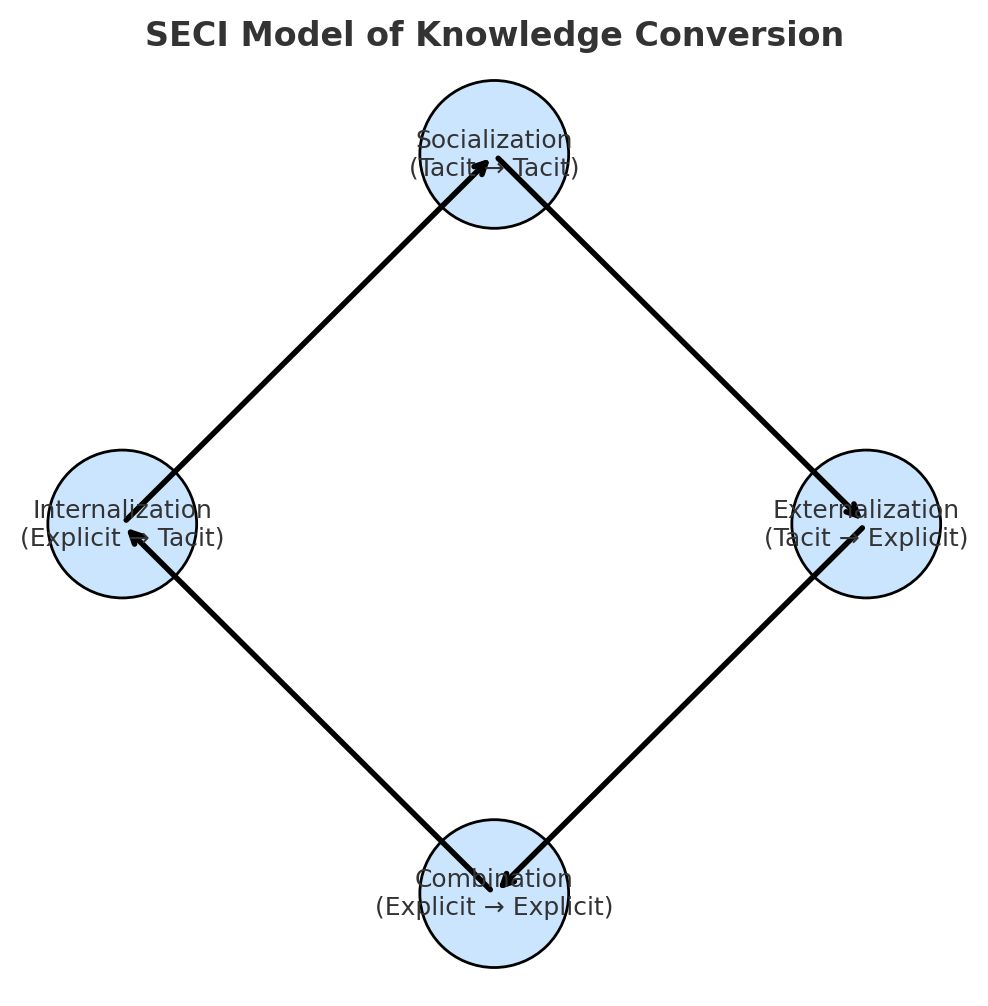
Before examining why the Externalization Gap exists, one must understand the theoretical framework that defines it. Nonaka & Takeuchi (1995) proposed the SECI model as a continuous spiral of knowledge conversion between tacit and explicit forms.
The Four Conversion Modes
- Socialization
- Tacit → Tacit Sharing through experience: apprenticeship, mentoring, shadowing.
- Externalization
- Tacit → Explicit Articulating concepts into shareable form. The critical bottleneck.
- Combination
- Explicit → Explicit Systemizing knowledge into documents, databases, procedures.
- Internalization
- Explicit → Tacit Learning by doing; explicit knowledge becomes embodied skill.
Research Starting Point
The research started with the SECI model, but its main weakness quickly became clear in high-stress environments: it assumes that Externalization will happen if people simply try hard enough.
Why SECI?
Nonaka and Takeuchi's The Knowledge-Creating Company (1995) is among the most cited works in management science. SECI has shaped knowledge management practice for three decades.
The Spiral Concept
SECI operates as a continuous spiral rather than a linear sequence. Knowledge cycles through all four modes repeatedly.
Academic Critiques
- Gourlay (2006): Externalization lacks operational definition. It's a metaphor without a mechanism.
- Tsoukas (2003): Tacit knowledge cannot be fully "converted". It remains context-dependent.
- Snowden (2002): SECI oversimplifies context, assuming universal applicability.
Presenter Notes
- Briefly explain the 4 quadrants. Don't get bogged down in theory, but establish the vocabulary.
- Focus on the Red Quadrant (Externalization): This is where the magic is supposed to happen, but often doesn't.
- Mention the critiques: The project isn't the first to say SECI is imperfect, but it proposes a specific fix for the Externalization step.
The Limits of SECI in High-Stress Environments
Why the "Knowledge Spiral" Breaks Down Under Pressure
SECI assumes Externalization occurs naturally given sufficient motivation. It describes that conversion happens, not how. This lack of operational mechanism causes failure in high-stress contexts.
The Core Problem
- Operational Gap SECI describes process, not mechanism. It offers a metaphor without a method for extraction.
- High-Stress Failure Standard interventions (e.g., "lessons learned") fail when investigators cannot articulate "gut feel" pattern matching.
Why SECI Fails for AI
- Context Blindness SECI relies on shared physical space (Ba). AI lacks this "situated cognition."
- The Articulation Gap Metaphor is insufficient for code. AI needs structured "Intuition Pumps" to elicit reasoning.
- Missing Verification SECI relies on social consensus. AI needs explicit "Quality Gates" to prevent hallucination.
EASCI: Operationalizing SECI
Where SECI offers a metaphor, EASCI supplies the engineering: specific protocols for externalization, quality gates for verification, and AI mediation for structure.
"We know more than we can tell."
— Michael Polanyi (1966)
Collins' Taxonomy (2010)
- Relational: Concealed by social dynamics.
- Somatic: Physically embodied skill.
- Collective: Distributed across a team.
Theoretical Limits
- Gourlay (2006): "Externalization" lacks operational definition.
- Tsoukas (2003): Context is inseparable from tacit knowledge.
- Von Hippel (1994): "Sticky information" resists transfer.
Presenter Notes
- Start with the Polanyi quote: it's the fundamental truth of this domain.
- Explain that SECI works fine for "business as usual" but breaks when things get chaotic.
- Key Point: AI cannot just "absorb" culture like a human apprentice. It needs explicit structures.
- Introduce EASCI as the "engineering fix" to SECI's "theoretical bug."
SECI Model: The Externalization Gap
Why SECI proved insufficient as a blueprint for system design
Scoping Review, Interviews, and Theoretical Analysis showed the same problem: SECI helps people build trust, but it does not help them express complex, experience-based knowledge.
Theoretical Failures
- Articulation Barrier Tacit knowledge is hard to explain. "We know more than we can tell."
- Mechanism Gap "Externalization" is a metaphor, not a process. No operational definition exists.
- Missing Cognition SECI ignores inference. Abduction and intuition pumps are required.
Example: Intuition Pump
"Imagine a new colleague is about to handle their first high-pressure incident alone. What's the one thing you'd want them to know that isn't in any manual?"
This bypasses the "what do you know?" block by creating a concrete, protective scenario.
"SECI was not enough for building a real system because it doesn’t explain how tacit knowledge becomes explicit. It describes the idea but not the mechanism."
Abductive Reasoning
Peirce (1903): The process of forming explanatory hypotheses. Unlike deduction (proving) or induction (generalizing), abduction infers the best explanation for a specific situation.
Intuition Pumps
Dennett (2013): Thought experiments designed to elicit intuitions. They bypass the Polanyi Paradox by asking "what would you do if...?" rather than "what do you know?".
Key References
- Polanyi (1966): The Tacit Dimension.
- Gourlay (2006): "Conceptualizing Knowledge Creation."
- Busch (2008): "Tacit Knowledge in Organizational Learning."
Presenter Notes
- Walk through the flow diagram: Green works, Red is broken.
- Explain why it's broken: The "Mechanism Gap."
- Use the "Intuition Pump" example to show how the system fixes it. Instead of asking "tell me what you know," the system asks "what would you tell a rookie?"
- This shift from direct questioning to scenario-based elicitation is the core of the approach.
The Role of AI in Tacit Knowledge Capture
Can a voice-controlled agent help externalize tacit knowledge?
The Externalization Problem
Tacit knowledge externalization fails because experts cannot easily verbalize what they know. Polanyi (1966) describes this as "we know more than we can tell." This is compounded by the Curse of Knowledge (Hinds, 1999): experts struggle to imagine what novices don't know, making direct transfer ineffective. Interview findings confirm that experts struggle to articulate reasoning under time pressure.
Socratic Mediation
TacitFlow does not replace human reasoning; it acts as a Socratic interviewer that prompts reflection and forces articulation (Dennett, 2013: intuition pumps; Dewey, 1938: inquiry as reflective practice). This differs from retrieval-augmented generation: the AI elicits rather than merely retrieves.
Why Not Traditional KM?
Traditional KM tools cannot support abductive or narrative reasoning (Gourlay, 2006; Collins, 2010). AI agents can observe interaction patterns, ask clarifying questions, and assist in forming structured Knowledge Objects, shifting from passive storage to active mediation.
Research Through Design
The methodological foundation is Research Through Design (Zimmerman, Forlizzi & Evenson, 2007), where the system is built to test theoretical assumptions. Leinonen et al. (2008) describe this as "Software as Hypothesis": a prototype used to validate theoretical constructs, not a commercial product.
This theoretical position creates the bridge to the EASCI framework.
The Socratic Method
Named after Socrates (470-399 BCE), the method uses guided questioning rather than direct instruction. The teacher asks probing questions that expose contradictions, forcing the learner to refine their understanding. TacitFlow's AI probes follow this tradition: asking questions that help experts articulate what they know.
Iterative Refinement
DBR's iterative cycles distinguish it from traditional experiments. Each TacitFlow iteration generates usage data that informs the next design phase, embodying DBR's commitment to theory-practice integration.
Cognitive Load Theory
Sweller (1988): Working memory has strict limits. TacitFlow's voice interface minimizes extraneous load (typing/navigating) to preserve germane load (reflection/articulation).
Recognition-Primed Decision
Klein (1993): Experienced practitioners recognize patterns rather than deliberating options. TacitFlow preserves these pattern libraries by capturing the cues experts notice.
Complex Thinking
Morin (2008): Complex phenomena require multiple perspectives. TacitFlow synthesizes pragmatism, process philosophy, organizational learning, and cognitive science.
Deep Smarts
Leonard (2005): Expert intuition built through years of experience. Unlike explicit knowledge in manuals, deep smarts are transferred through guided experience and Socratic dialogue.
Psychological Safety
Edmondson (1999): Essential for sharing. Experts must feel safe revealing their "tricks" without fear of judgment. TacitFlow addresses this through anonymous draft submission and mentor-mediated validation.
Mental Models
Internal representations (e.g., "suspicious behavior"). TacitFlow captures mental models through structured articulation and makes them visible for peer validation.
Avoiding Competency Traps
March (1991): Organizations that over-exploit existing knowledge fall into "competency traps." EASCI balances exploitation (Consolidation) with exploration (Innovation).
Process Philosophy
Whitehead: Actual Entities are "drops of experience." Concrescence is the integration of data into a new unity. In TacitFlow, each Knowledge Object is a concrescence of prior data, perspective, and AI structuring.
Collins' Taxonomy (2010)
Relational: Concealed by social
dynamics.
Somatic:
Embodied.
Collective:
Social.
TacitFlow targets relational and
somatic knowledge through conversational
elicitation.
Experiential Learning
Kolb (1984): Concrete Experience → Reflective Observation → Abstract Conceptualization → Active Experimentation. EASCI maps directly onto this cycle.
Miller's Law (7±2)
Working memory holds ~7 chunks. EASCI's structured stages respect this limit by processing knowledge incrementally.
Curse of Expertise
Hinds (1999): Experts cannot "unlearn" expertise to imagine a beginner's perspective. TacitFlow's AI probes address this by asking the questions novices would ask.
Presenter Notes
- The "Why": AI is used not just to record, but to provoke.
- The "How": Socratic questioning. The AI plays the role of the "naive learner" to force the expert to explain things clearly.
- Theoretical Basis: This isn't just a tech demo; it's "Research Through Design." It was built to test if this kind of capture is even possible.
- Highlight Psychological Safety: If cops/firefighters don't feel safe, they won't talk. The system is designed for that.
A Proposed Alternative to SECI: The EASCI Framework
Externalization as five governed stages, not one assumed conversion
EASCI addresses SECI's externalization gap. Where SECI names the tacit-to-explicit bridge, EASCI operationalizes it as a lifecycle of typed artifacts, quality gates, explicit provenance, and bounded AI roles.
| Stage | Name | Artifact | Function and AI Boundary |
|---|---|---|---|
| E | Experience | Context metadata record | Captures situated context before interpretation. AI may transcribe or capture metadata; it must not summarize or interpret. |
| A | Articulation | Experiential fragment | Surfaces partial reasoning through prompts and voice capture. AI may elicit; the practitioner authors the content. |
| S | Structuring | Provisional Knowledge Object | Organizes fragments into abductive explanations with counter-hypotheses, disconfirming evidence, and provenance. |
| C | Consolidation | Validated Knowledge Object | Peer validation records endorsement, revision, or dissent. AI may surface related artifacts but must not validate. |
| I | Innovation | Managed Knowledge Object | Triggers review, versioning, supersession, and retirement. AI may flag declining relevance; humans retire knowledge. |
Why EASCI?
EASCI treats externalization as three distinct cognitive operations: guided articulation, abductive structuring, and social validation. Experience anchors context before the work begins; Innovation governs revision and retirement after validation.
Design Principles in One Sentence
- Cognitive plausibility: partial articulation is expected; context must be captured as operative constraints.
- Social calibration: artifacts need reuse conditions, explicit validation, and preserved dissent.
- AI boundaries: GenAI can elicit, scaffold, and challenge, but it cannot author, validate, suppress dissent, or retire knowledge.
Theoretical Backbone
This framework is the theoretical backbone that TacitFlow operationalizes. Each stage maps to a typed artifact, a quality gate, and a deliberately bounded AI role.
Seven Foundations
The framework maps grounded cognition, cognitive load theory, abductive reasoning, sensemaking, transactive memory, process philosophy, and organizational learning to specific stages.
Field Example
Pragmatist Standard
EASCI does not claim a perfect translation of tacit states. It asks whether an artifact is practically adequate for organizational use, with adequacy judged socially at Consolidation.
Machine-Checked Invariants
The Lean report formalizes structural properties such as provenance acyclicity, gate monotonicity, series-system composition, and CCVE taxonomy embeddings, while explicitly tracking remaining proof debt.
Presenter Notes
- EASCI vs SECI: Emphasize that SECI is a "what" model, EASCI is a "how" model.
- The Gap: SECI's externalization phase is split into recall, structuring, and validation because these are different cognitive operations.
- AI Boundary: AI is most useful before validation, where it prompts, structures, and challenges without acquiring authority.
- Formal Link: Note that the framework's structural invariants now have a Lean 4 formalization, but empirical effectiveness is still being tested.
The Philosophical Move: From Perfect Capture to Warranted Use
EASCI does not try to extract the whole of tacit knowing; it governs partial externalization.
The older tacit-knowledge debate creates a false binary: either tacit knowledge can be converted into explicit form, or it is ineffable and cannot be captured at all. EASCI takes a pragmatist third path.
Polanyi
“We know more than we can tell.” Expertise includes subsidiary awareness, embodied attention, and background judgment that cannot be fully verbalized.
SECI Tension
SECI correctly identifies externalization as the critical bridge, but often treats conversion as if a supportive context is enough.
Dewey
Warranted assertibility shifts the standard from perfect representation to socially testable practical adequacy.
The EASCI Standard
A Knowledge Object does not need to be a complete translation of an expert's tacit state. It must be useful for the organizational purpose, traceable to its origins, explicit about its limits, and validated by accountable peers.
The Pragmatist Bypass
EASCI bypasses the “can tacit knowledge be fully converted?” impasse by asking whether a partial artifact is good enough to guide future inquiry and action.
Tsoukas Still Matters
Tsoukas's objection survives: some subsidiary awareness cannot become focal without changing its character. EASCI responds by limiting the claim, not by denying the problem.
How the New Governance Changes This
Quality gates, counter-hypothesis records, and PLE make “adequacy” inspectable rather than rhetorical. The artifact's warrant is procedural and social.
Presenter Notes
- Make clear that EASCI is not promising total capture of tacit knowledge.
- Use Dewey to explain why peer validation is philosophical, not just administrative.
- Connect “warrant” to gates: adequacy is tested through process records.
What Kind of Tacit Knowledge Can EASCI Touch?
Collins gives the boundary conditions; Lean keeps the taxonomy honest.
The framework does not treat all tacit knowledge as the same. It targets knowledge whose barriers are social, contextual, motivational, or partially embodied, while acknowledging that some collective practice cannot be captured by individual artifacts.
Relational Tacit Knowledge
Could be articulated, but remains tacit because of context, trust, incentives, or missing elicitation.
EASCI fit: strongest target.
Somatic Tacit Knowledge
Embodied skill and perceptual-motor judgment acquired through practice.
EASCI fit: captures contextual anchors and articulable residue, not the skill itself.
Collective Tacit Knowledge
Norms and practices held by a community rather than an individual mind.
EASCI fit: requires socialization and Consolidation; individual capture is insufficient.
| Taxonomy | What it adds | EASCI treatment |
|---|---|---|
| Collins | RTK / STK / CTK boundaries | Defines what can be externalized, partially anchored, or left to social practice. |
| Blackler | Embrained, embodied, encultured, embedded, encoded forms | Explains why KOs must carry context, authorship, and reuse conditions. |
| Spender | Individual/social × conscious/automatic quadrants | Explains why peer validation is not optional: some knowledge is social by construction. |
CCV and CCVE
The Lean report represents Collins-style knowledge composition as a simplex. CCVE adds the explicit fraction produced by successful externalization.
Why Formalize a Taxonomy?
Formalization prevents hand-waving across categories. If a mapping preserves simplex structure, the framework can compare knowledge-type mixtures without pretending they are identical.
Design Consequence
TacitFlow should ask “what kind of tacit knowledge is this?” before selecting prompts, gates, reviewers, or reuse boundaries.
Presenter Notes
- Do not imply EASCI captures CTK by recording individuals.
- Explain that the formal model is a guardrail against category confusion.
- Use this slide to justify why “partial capture” is a principled limitation.
Situated and Embodied Knowing
Experience is not background metadata; it is part of the knowledge.
Expert judgment is often encoded in perception, bodily familiarity, and ready-to-hand practice. EASCI's Experience stage exists because stripping context at the moment of capture destroys the cues that make later interpretation possible.
The Phenomenological Claim
- Merleau-Ponty: knowing is embodied engagement with the world, not detached inspection.
- Dreyfus: expertise moves from rule-following to absorbed coping.
- Trubody: prompts can create controlled breakdowns that shift ready-to-hand practice into present-at-hand reflection.
The Cognitive Claim
- Anderson: knowledge compilation makes intermediate reasoning hard to access.
- Barsalou: grounded cognition reactivates perceptual and motor traces.
- Wickens: voice capture uses auditory-vocal resources while fieldwork occupies visual-manual resources.
Updated Design Consequence
TacitFlow Field should capture contextual anchors, affective cues, hesitation, confidence, and timing as first-class evidence for later review. Voice-first capture is therefore not convenience; it is a cognitive-load and fidelity intervention.
Micro-Ba
Nonaka's Ba assumes sustained shared context. EASCI's micro-Ba is a short, prompted reflective space created in the field when co-presence is unavailable.
Why Voice Survives the Update
The newer ECCE framing strengthens the voice argument: speech reduces dual-task load and preserves paralinguistic cues for Consolidation.
Gate Implication
G1 is not a bureaucratic form. It protects the context needed for later Articulation, Structuring, and reuse.
Presenter Notes
- Use this slide to recover the embodied-cognition argument.
- Stress that Experience precedes Articulation because context is part of meaning.
- Connect micro-Ba to practical constraints: no meeting, no keyboard, no long debrief.
Knowledge Becomes Organizational Through Social Judgment
Consolidation is a social-science claim, not a workflow checkbox.
EASCI treats organizational knowledge as something negotiated, remembered, and renewed by a community. A model can surface patterns; it cannot supply professional legitimacy.
Weick: Sensemaking
Ambiguous situations become actionable through plausible accounts negotiated by practitioners.
Wegner: Transactive Memory
Organizations remember partly by knowing who knows what. Validation events map expertise networks.
Argyris and Schön: Learning Loops
Single-loop feedback corrects execution; double-loop feedback revises governing assumptions.
Updated EASCI Mechanisms
- Preserved dissent: minority interpretations stay attached to the KO.
- Peer review: validation requires professional standing, not model confidence.
- Eleven feedback paths: social judgments reshape prompts, metadata requirements, validation norms, and lifecycle triggers.
- PLE-3: review history becomes auditable process evidence.
Why AI Cannot Validate
Validation is not only a consistency check. It is a claim that this explanation is credible to a professional community under current conditions. That requires accountability, shared practice, and the possibility of dissent.
Psychological Safety
The interview findings still matter: if practitioners fear blame, surveillance, or loss of credit, they will not contribute useful tacit knowledge.
Trust Barrier
Attribution through PROV-O helps address a social dilemma: contributors can see how their knowledge is credited, reused, and reviewed.
Regulatory Link
Social review and dissent records support contestability: reviewers can see which alternatives were considered and why one interpretation was accepted.
Presenter Notes
- Make the sociological point: organizational memory is not just storage.
- Connect trust and psychological safety back to the empirical interviews.
- Use this slide to justify the non-delegable Consolidation gate.
Process Philosophy and Temporal Governance
Knowledge is not a static object in a vector store; it is a managed becoming.
The Innovation stage brings back the process-philosophy framing: organizational knowledge must be revised, superseded, and sometimes intentionally forgotten as conditions change.
Whitehead
The settled past becomes data for new occasions. Validated KOs shape future perception, but they must remain open to novelty.
Kluge and Gronau
Organizations need intentional forgetting so obsolete routines do not keep governing new situations.
EASCI
Innovation records review triggers, supersession links, retirement decisions, and new Experience-stage prompts.
new conditions
new fragments
new hypotheses
new judgment
new governance
The lifecycle is not “add more data.” It is controlled renewal: each accepted artifact can later become evidence, constraint, precedent, or object of retirement.
Zombie Facts
A validated KO can become harmful when conditions change. Innovation prevents outdated knowledge from retaining authority through retrieval alone.
PLE-5
Evolution records how knowledge changes: review triggers, retirement events, and supersession links become part of the explanation.
Lean Connection
The formal model treats lifecycle governance as structure, not metaphor: provenance ordering, acyclicity, and gate monotonicity are properties to preserve.
Presenter Notes
- Recover the Whitehead/process-philosophy framing without making it decorative.
- Explain why Smart Forgetting is a governance mechanism, not a cleanup task.
- Connect Innovation to both regulatory compliance and organizational learning.
EASCI Framework: The Knowledge Lifecycle
Five typed artifacts, five quality gates, and eleven auditable feedback paths
Unlike SECI's spiral metaphor, EASCI names the stage transitions and records them as auditable process events.
Theoretical Backbone
This framework is the governance backbone that TacitFlow operationalizes. Each stage maps to an artifact type, an AI permission boundary, and a promotion gate.
Why EASCI?
SECI says tacit knowledge can become explicit but leaves externalization underspecified. EASCI separates recall, organization, and social calibration so the interface can reduce cognitive load without handing authority to the model.
Stage Mechanisms
- Experience: preserves contextual anchors before abstraction begins.
- Articulation: captures partial practitioner reasoning as experiential fragments.
- Structuring: produces provisional KOs with counter-hypotheses and disconfirmation criteria.
- Consolidation: requires peer review, rationale, and dissent preservation.
- Innovation: handles supersession, versioning, triggered review, and controlled retirement.
Feedback Architecture
The ECCE paper specifies eleven feedback paths. Single-loop paths correct execution parameters; double-loop paths revise organizational norms; deep paths propagate Innovation-stage insights.
Quality Gates
G1-G3 certify epistemic quality; G4-G5 certify social validation and lifecycle governance. A validated artifact has passed the whole series, not just a model confidence threshold.
Process-Level Explainability
PLE records how an artifact was produced, challenged, validated, reused, and updated. This complements model-level XAI by explaining organizational knowledge production.
Formal Status
The Lean 4 report mechanizes key structural properties and uses scaled-integer arithmetic for decidable checks, while distinguishing completed kernel-checked proofs from tracked proof obligations.
Why Five Stages?
Three stages decompose SECI externalization; Experience and Innovation supply the contextual and temporal governance SECI leaves implicit.
Presenter Notes
- The Loop: Focus on the visual. It's not a line, it's a cycle.
- Feedback: Point out that the newer paper names eleven paths rather than relying on a generic loop.
- Gates: Make clear that promotion is not automatic: every artifact must pass explicit criteria.
- AI Role: The AI helps elicit, structure, and challenge, but authority remains with practitioners and reviewers.
EASCI Stages 1-3: Capture & Structure
The Capture Phase (E-A-S)
Stages 1-3 form the epistemic-quality phase: preserve context, capture partial reasoning, then build a provisional Knowledge Object that can be challenged before review.
1. Experience: Contextual Anchoring
Artifact: a context metadata record. The stage captures triggers, constraints, observed signals, case links, and timing before the practitioner is asked to explain them.
2. Articulation: Partial Reasoning Capture
Artifact: an experiential fragment. The practitioner records what they noticed, suspected, recalled, or judged without having to produce a polished explanation.
3. Structuring: Abductive Explanation Building
Artifact: a provisional Knowledge Object. Fragments become an explanatory claim with linked evidence, applicability conditions, confidence, and explicit alternatives.
Why Three Stages for Capture?
SECI assumes tacit-to-explicit conversion happens within a broad externalization mode. EASCI separates contextual anchoring, recall, and explanation-building so each operation has an appropriate interface and gate.
From Tacit to Explicit: The Gap EASCI Fills
Nonaka's SECI model identifies what needs to happen but not how. EASCI fills that gap through artifact types, provenance, counter-hypothesis testing, and quality thresholds rather than relying on spontaneous narration.
Situated Learning
Brown & Duguid (1991) argue that canonical descriptions of work often diverge from actual practice. Real learning happens through legitimate peripheral participation within communities of practice.
Embodied Cognition
Merleau-Ponty (1945) argued knowledge is grounded in bodily experience. TacitFlow's Experience stage captures pre-reflective patterns through behavioral observation.
Maurice Merleau-Ponty (1908-1961)
French phenomenologist who established the body as the primary site of knowing. Against Cartesian dualism, he argued that perception is active embodied engagement. TacitFlow captures this through contextual metadata.
Phenomenology
Study of conscious experience from a first-person perspective (Husserl). It treats subjective experience as valid data, not bias to be eliminated.
Cartesian Dualism
Descartes' separation of mind and body. Merleau-Ponty's critique grounds tacit knowledge theory: knowing involves the whole embodied person.
Abductive Mapping
Peirce distinguished abduction (guessing best explanation) from deduction and induction. Structuring uses abduction to generate hypotheses from sparse evidence.
Exploration vs. Exploitation
March (1991): Organizations must balance efficiency (exploitation) with innovation (exploration). EASCI structures this tension.
Capture Phase in Practice
Example: Investigator notices an anomalous transaction pattern.
E: Case context and source traces are recorded.
A: Voice fragment captures the hunch and confidence.
S: KO states the explanation, counter-hypothesis, and disconfirming evidence.
Communities of Practice
Lave & Wenger (1991): Knowledge transfer occurs through "legitimate peripheral participation". TacitFlow uses mentor-novice pairing.
Grounded Cognition
Barsalou (2008): Conceptual knowledge involves modal simulations. Expert judgment relies on "feeling" if a situation matches prior patterns.
Cognitive Apprenticeship
Collins et al. (1989): Modeling, coaching, scaffolding, and fading. AI probes function as scaffolding that fades as reasoning improves.
Reflective Practice Feedback Loop
Schön (1983): "Reflection-in-action". Innovation reveals gaps, prompting refinement of Articulation methods.
Pattern Recognition Feedback Loop
Simon (1996): Experts recognize patterns. Innovation helps identify recurring structures, improving Structuring.
Legitimate Peripheral Participation
Newcomers learn by participating at the edges of practice. TacitFlow operationalizes this through guided observation.
Bounded Rationality
Simon (1957): Humans use heuristics due to limited processing power. KOs provide pre-organized knowledge to reduce search costs.
Presenter Notes
- Load Reduction: The user is not asked to recall, organize, and validate at the same time.
- Voice: Voice preserves context and paralinguistic cues while keeping visual-manual attention available.
- Gate G3: Counter-hypothesis is a workflow requirement, not an optional advice pattern.
EASCI Stages 4-5: Consolidate & Evolve
The Validate Phase (C-I)
Stages 4-5 form the social and lifecycle governance phase: professional judgment validates provisional KOs, and Innovation prevents obsolete knowledge from remaining authoritative.
4. Consolidation: Peer Validation and Dissent Preservation
Artifact: a validated Knowledge Object. Reviewers record endorsement, revision, or dissent with rationale; disagreement is preserved as governance signal, not suppressed as noise.
5. Innovation: Review, Supersession, and Controlled Retirement
Artifact: a managed Knowledge Object. Innovation sets review triggers, records supersession links, and deliberately retires knowledge that no longer fits operational or regulatory conditions.
Why Validation Requires Two Stages?
Validation requires professional standing and interpersonal accountability. Lifecycle governance requires contextual judgment about whether a claim still holds; both are deliberately non-delegable to AI.
Reflection-in-Action vs. Reflection-on-Action
Schön distinguished two reflective modes: Reflection-in-action occurs during performance (e.g., jazz improvisation). Reflection-on-action occurs afterward. TacitFlow's voice capture supports both: in-the-moment observations and post-event debriefs.
The Compounding Effect
By formalizing the feedback loops (e.g., Double-Loop Learning), the system turns linear investigation steps into a compounding asset. Each case solved makes the next one faster, creating institutional memory that survives personnel turnover.
Smart Forgetting Protocol
Innovation requires unlearning. This protocol ensures outdated intelligence (e.g., disproven hypotheses) is actively pruned to prevent "zombie facts."
Social Verification as Quality Gate
Von Krogh et al. (2000): Knowledge creation requires "enabling conditions" like trust and empathy. TacitFlow's mentor circles operationalize this, surfacing tacit disagreements to prevent hallucination loops.
Double-Loop Learning
Argyris & Schön (1978): Unlike single-loop learning (correcting errors), double-loop learning questions governing assumptions. It supports revising protocols when standard methods fail.
Social Learning Theory
Bandura (1977): Learning occurs through observation and modeling. TacitFlow's mentor circles create observational learning opportunities.
Observational Learning
Learning by watching others. Components: attention, retention, reproduction, motivation. TacitFlow makes validated expert KOs visible to learners.
Validate Phase in Practice
Consolidation: Mentor circle reviews KO. Senior confirms pattern. Junior dissents. Consensus reached → KO enters vector store.
Innovation: New case law changes standards. Smart Forgetting flags KO. Expert reviews and retires it with provenance trail.
Embodied Knowledge Feedback Loop
Merleau-Ponty (1945): Structuring creates cognitive schemas that become the pre-reflective lens for future Experience.
Organizational Memory Feedback Loop
Walsh & Ungson (1991): Consolidated KOs become the institutional vocabulary that shapes how practitioners articulate new experiences.
Double-Loop Learning Feedback Loop
Innovation back to Experience reframes the entire knowledge capture process, creating fundamental shifts in practice.
Stable Tacit Practices
Practices are not static but actively performed. Consolidation creates "relative stability" where knowledge is routinized yet subject to re-enactment.
Destabilization Events
External shocks or anomalies force a shift from unreflective habit to active sensemaking (Dewey's "problematic situation").
Metacognition
Flavell (1979): "Thinking about thinking." TacitFlow's reflective probes develop awareness of one's own cognitive processes.
Lures for Feeling
Whitehead: Validated KOs become "lures" that shape how practitioners perceive future situations.
Resilience Engineering
Hollnagel (2011): Innovation enables adaptive capacity by updating mental models based on accumulated experience.
Presenter Notes
- Social Verification: Emphasize that AI alone cannot validate tacit knowledge; human consensus is required.
- Smart Forgetting: This is crucial for preventing "zombie facts" in the vector store.
- Feedback Loops: Show how Innovation feeds back into the start of the cycle (Experience), creating a continuous learning engine.
Why a Voice-First Approach for TacitFlow?
Multiple-resource capture for field conditions and fragile expertise
The Bandwidth Gap
Explicit Only: Written reports force users to filter out "irrelevant" details, often discarding the tacit context.
Rich Signal: Voice captures how something is said (hesitation, urgency, confidence), which is critical metadata for intelligence.
Situated Interaction
Tacit knowledge rarely appears in formal documents; it emerges during situated action. Voice creates a short “micro-Ba”: a prompted reflective space that can occur in seconds without requiring a meeting, desk, or keyboard.
Cognitive Load Evidence
Multiple Resource Theory predicts that speech reduces visual-manual interference during fieldwork. The source paper cites speech input at roughly 153 WPM versus 52 WPM for touchscreen typing, with paralinguistic cues preserved for later validation.
The "Sticky" Knowledge Problem
Von Hippel (1994) showed that tacit knowledge is "sticky," bound to the context where it was developed. TacitFlow reduces this loss by linking voice fragments to contextual metadata, source traces, and PROV-O attribution.
Overcoming Sharing Dilemmas
Cabrera & Cabrera (2005) identify knowledge sharing as a social dilemma where collective benefit is high but individual costs (time, status risk) disincentivize contribution. TacitFlow addresses this through:
- Attribution: Visible credit for contributions builds self-efficacy.
- Low Friction: Voice reduces the effort cost of sharing.
- Social Norms: Peer validation celebrates sharing.
Validation Approach
The voice-first advantage remains a theoretical prediction grounded in cognitive analysis. Planned evaluation includes controlled fragment-completion comparisons, NASA-TLX workload measurement, and longitudinal field deployment.
Self-Determination Theory
Deci & Ryan (2000): Intrinsic motivation depends on autonomy, competence, and relatedness. TacitFlow's voice-first design supports personal agency (choosing what to share) rather than forcing structured input.
Self-Efficacy
Bandura (1977): Belief in one's ability to succeed. TacitFlow builds efficacy through structured success experiences and visible attribution.
Paralinguistic Information
Voice captures hesitation, emphasis, and tone: metadata for tacit judgment. Polanyi (1966) noted experts often "feel" rightness before they can explain it. Audio preserves these signals; text discards them.
Contextual Metadata
Data about data capturing creation circumstances. TacitFlow captures:
- Temporal: Timestamp, duration.
- Spatial: GPS, zone.
- Social: Presence, supervisor.
- Operational: Case #, incident type.
- Physiological: Heart rate (stress).
Situated Interaction
Brown, Collins & Duguid (1989): Knowledge is inseparable from the activity and context in which it develops.
Subtle Cues
Audio captures confidence or uncertainty. Experts often "feel" rightness before they can explain it.
Presenter Notes
- Why Voice? It's not just convenience; it's about capturing the "sticky" context and emotional nuance that text misses.
- Motivation: Explain how we use Self-Determination Theory to make people want to share.
- The Dilemma: Acknowledge that sharing is hard/risky. Show how we lower the cost (voice) and raise the reward (attribution).
How EASCI Informs TacitFlow’s Design
Operationalizing governance with artifacts, provenance, and human authority boundaries
Core Principle: EASCI defines the artifact lifecycle; TacitFlow implements it as a dual-interface system where mobile capture supports Experience/Articulation and the desktop workbench supports Structuring, Consolidation, and Innovation.
| Stage | Artifact | TacitFlow Implementation | AI Boundary / PLE |
|---|---|---|---|
| Experience | Context record | Mobile field capture records time, source, case context, and situational constraints. | AI captures metadata only; PLE-1 provenance begins. |
| Articulation | Experiential fragment | Voice prompts elicit what the practitioner noticed, suspected, recalled, or judged. | AI may prompt/transcribe; human authorship preserved. |
| Structuring | Provisional KO | Workbench links fragments, evidence, counter-hypotheses, confidence, and reuse conditions. | AI suggests alternatives; PLE-2 rationale records dispositions. |
| Consolidation | Validated KO | Peer reviewers record endorsement, revision, dissent, and rationale. | No AI validation; PLE-3 review preserves accountability. |
| Innovation | Managed KO | Lifecycle triggers review, versioning, supersession, and controlled retirement. | AI may flag drift; PLE-5 records evolution and invalidation. |
Knowledge Objects (KOs)
A Knowledge Object is TacitFlow's atomic unit: a typed, versioned claim bundling an explanation, linked fragments, evidence, alternatives, applicability conditions, confidence, and provenance.
PROV-O maps KOs as prov:Entity, with
relations tracking who articulated them, how they
were derived, which alternatives were considered,
who reviewed them, and when they were superseded or
invalidated.
Process-Level Explainability (PLE)
PLE extends accountability from a model output to the whole organizational knowledge lifecycle. It asks whether reviewers can reconstruct the process that produced, challenged, validated, reused, and updated a claim.
- PLE-1 Provenance: who produced what, in which experience context.
- PLE-2 Rationale: which alternatives and counter-hypotheses were considered.
- PLE-3 Review: who validated, revised, or dissented.
- PLE-4 Reuse Conditions: where the claim applies and where it does not.
- PLE-5 Evolution: how the claim changed, expired, or was superseded.
Knowledge Object Structure
Each KO contains:
- Claim: the asserted knowledge statement
- Evidence: supporting sources and observations
- Confidence: weighted score based on evidence quality
- Provenance: full derivation chain per W3C PROV-O
- Metadata: timestamps, classification labels, contributor IDs
- Relations: typed links to other KOs in the graph
PROV-O Vocabulary
PROV-O (W3C, 2013) is the OWL representation of PROV-DM. TacitFlow serializes all KO provenance as PROV-O-compliant RDF, enabling interoperability with any PROV-aware system.
From "Sticky" to Traceable
Von Hippel (1994) identified tacit knowledge as "sticky": costly to transfer because context is lost. PROV-DM embeds context (situational metadata, derivation history) directly into the knowledge structure.
Addressing the Trust Barrier
Reluctance to share often stems from lack of
attribution. PROV-DM's
wasAttributedTo ensures contributors
receive explicit credit, transforming sharing into a
documented contribution.
Ontology (Information Science)
A formal specification of a conceptualization. Unlike a taxonomy, ontologies capture complex relationships (e.g., "an officer can supervise multiple incidents").
Taxonomy vs. Ontology
Taxonomy: Tree structure (is-a).
Dog is an animal.
Ontology:
Graph structure (arbitrary relations). Dog is
owned-by Person.
The Provenance Chain
Creation Trail (who/when) → Derivation Trail (reasoning logic) → Access Trail (retrieval). All trails are W3C PROV-O compliant.
Audit Trail Architecture
TacitFlow maintains three audit layers ensuring full accountability and traceability for every piece of knowledge in the system.
Presenter Notes
- Provenance is Key: Emphasize that we aren't just storing text; we are storing the history of the knowledge. This builds trust.
- Standards: Mention W3C PROV-DM. This isn't a proprietary format; it's an open standard for interoperability.
-
Attribution: Point out how the
wasAttributedTorelation directly solves the "why should I share?" problem by guaranteeing credit.
The EASCI Lifecycle
The macro loop: how artifacts advance only through explicit quality gates
A transparent, human-led process for moving from situated experience to governed organizational memory. The macro loop is not model retraining; it is artifact promotion through gates, provenance, peer validation, and lifecycle review.
The system adapts the EASCI framework (Experience → Articulation → Structuring → Consolidation → Innovation) to govern AI-supported knowledge work. Each stage produces a typed artifact; each transition has a gate; each feedback path becomes an auditable event.
Quality Gate Instrumentation
Every promotion must pass a gate. G1-G3 certify epistemic quality; G4-G5 certify social validation and lifecycle governance.
| Gate | Transition | Artifact | Pass Condition |
|---|---|---|---|
| G1 | Experience → Articulation | Context Record | Context fields meet threshold; timestamp and case link present. |
| G2 | Articulation → Structuring | Experiential Fragment | At least one decision point or reasoning step documented. |
| G3 | Structuring → Consolidation | Provisional KO | Complete provenance, reuse conditions, counter-hypothesis, and coherence threshold. |
| G4 | Consolidation → Innovation | Validated KO | Minimum endorsements present; dissent addressed or preserved with rationale. |
| G5 | Innovation → Experience | Managed KO / Innovation Record | Review trigger set; supersession link and lifecycle metadata complete. |
The Tacit Knowledge Gap
The framework is designed for experience-dependent, partially ineffable expertise where peer review is feasible and knowledge holders are accessible while reasoning is still fresh.
Series-System Logic
The formal report models gate composition as a series system: the artifact advances only if every required gate succeeds.
Gate Diagnostics
A failed gate reports which condition failed and what remediation is possible, turning governance into a cognitive scaffold rather than an opaque rejection.
Why Gates Matter
Without gates, GenAI can turn unvalidated fragments into authoritative-looking organizational memory. EASCI blocks that escalation by design.
Nonaka's SECI Model
EASCI keeps SECI's insight that externalization matters, but replaces the single phase with staged artifacts, boundaries, gates, and feedback paths.
Smart Forgetting
Innovation requires not just learning, but unlearning. Kluge & Gronau (2018) showed that organizational knowledge must be actively pruned. "Smart Forgetting" invalidates outdated KOs to prevent "zombie facts."
Smart Forgetting & Creative Advance
Whitehead's (1929) "creative advance into novelty" reframes this: the settled past (validated KOs) becomes the platform for future innovation. The Innovation stage retires obsolete knowledge while generating new experiential context.
Complexity at the Edge
Stacey's Complex Responsive Processes (2000) and Kauffman's At Home in the Universe (1995) explain why the feedback loops produce non-linear, emergent outcomes. The compounding effect emerges from self-organizing interactions across EASCI stages.
Edge of Chaos
A metaphor from complexity science describing the boundary zone between order and randomness where complex systems exhibit maximum adaptability and creativity. Effective organizations operate at this productive boundary.
Transactive Memory System
Wegner (1995): Organizations remember collectively through a distributed cognitive network where members know "who knows what." TacitFlow operationalizes TMS by explicitly mapping expertise networks.
GDPR Compliance
GDPR Art. 17: The Innovation phase includes data retirement protocols. When KOs are superseded, the system maintains audit trails while pruning operational data per Art. 17 (Right to Erasure) requirements.
Presenter Notes
- The Macro Loop: This is governance, not simply memory accumulation.
- Gates: Emphasize that quality control is built into transitions, not added after the fact.
- Lifecycle: Innovation prevents drift by reviewing, superseding, or retiring KOs as conditions change.
The Devil's Advocate Reasoning Cycle
From oracle-style answers to provenance-backed hypothesis stress-testing
While the macro loop governs knowledge over time, the micro loop runs during a reasoning session. It implements the ICAIL demo pattern: retrieve evidence, maintain competing hypotheses, challenge assumptions, and record the reasoning trace before any conclusion hardens.
The Session-Level Process
EvidenceRetriever and PatternSpotter query the knowledge graph for case documents, prior KOs, regulations, and source traces. The system starts from retrievable evidence, not model memory.
EvidenceIntegrator structures the primary account, while Devil's Advocate and Skeptic generate grounded counter-hypotheses and Socratic questions. Bayesian weights remain visible as evidence changes.
The Orchestrator and ComplianceReporter export a reasoning graph, provenance-backed trace, and compliance-supporting documentation such as FRIA inputs where required.
System Comparison
| Feature | Oracle-Style LLM | TacitFlow / AI Investigator |
|---|---|---|
| Memory | Ephemeral Context Window | Persistent Knowledge Graph with validated KOs |
| Truth Source | Training Weights (Black Box) | Retrieved evidence, operational traces, and PROV-O |
| Reasoning | Probabilistic Token Prediction | Inquiry dialogue, abduction, counter-hypotheses |
| Output | Unstructured Text | Reasoning graph, provenance trace, provisional KO |
| Accountability | Post-hoc explanation at best | Ante hoc process explanation generated during reasoning |
Why This Matters: The Oracle vs. Sparring Partner Gap
The goal is not to make AI more confident. It is to keep uncertainty visible: competing hypotheses, disconfirming evidence, source links, and compliance status remain inspectable throughout the investigation.
Micro vs Macro Loop
- Micro-Loop
- Session-level inquiry: evidence foraging, hypothesis challenge, provenance export.
- Macro-Loop
- Strategic knowledge governance (EASCI).
GraphRAG (Edge et al., 2024)
Connecting LLMs to knowledge graphs produces more accurate, traceable responses than document-based RAG alone. The graph structure enables reasoning over relationships, not just retrieving text chunks.
Devil's Advocate Pattern
The agent argues against the investigator's current hypothesis using evidence retrieved from the graph, then requires a documented disposition rather than passive acceptance.
Bayesian Weights
The ICAIL scenario keeps H1 and H2 weights visible as evidence arrives, showing non-monotonic movement rather than a one-way march to confirmation.
Socratic Challenge
Questions target missing evidence, unexamined assumptions, and internal contradictions. The investigator must articulate why one hypothesis should survive.
Complexity & Emergence
Kauffman (1995) showed complex systems self-organize at the "edge of chaos." The Micro Loop's cyclic process mirrors this: emergent intelligence arises from constrained iteration, not linear prediction.
Heuristics
Heuristics (availability, representativeness) enable fast decisions but introduce bias. TacitFlow's structured KOs provide reliable anchors to correct these biases (Kahneman, 2011).
Memory Architecture
LLMs have ephemeral context windows (128k–200k tokens). TacitFlow's Knowledge Graph persists indefinitely, transforming the assistant from a "stateless oracle" to a "learning partner."
Token Prediction vs. Reasoning
Standard LLMs predict the next token based on statistics. TacitFlow forces a different process: retrieve evidence, reason over it, then validate.
Multi-Hop Reasoning
Answers questions requiring multiple connected facts (e.g., "Who trained the officer who handled Case X?"). Vector search cannot traverse these relational chains; GraphRAG can.
Semantic vs. Keyword Search
Keyword: exact matches. Semantic: conceptual similarity ("routine patrol" $\approx$ "standard rounds"). TacitFlow combines both.
Dense Retrieval
Uses neural networks to encode queries and documents into dense vectors. Similarity is computed via cosine distance, capturing semantic relationships unlike sparse methods (BM25).
Theoretical Foundations
- Dewey: Knowledge is dynamic transformation ("situated inquiry").
- Dennett: "Intuition pumps" force externalization of tacit assumptions.
- Peirce: Abduction generates hypotheses from sparse evidence.
- Weick: Knowledge is "enacted" through social narrative.
- Whitehead: "Creative advance" - past KOs become data for new models.
Workplace Learning
Eraut (2004): Most learning is informal. The "Experience" stage captures authentic practice rather than formal documentation.
Social Knowledge
Tacit transfer depends on trust (Leonard & Sensiper). Mentor circles and verification address sharing barriers (Cabrera & Cabrera).
Presenter Notes
- The Micro Loop: This is the live investigation workflow, not the long-term knowledge lifecycle.
- GraphRAG: Emphasize source-bounded challenges rather than speculative adversarial imagination.
- Reasoning vs. Prediction: The system records inquiry steps so explanations are produced during reasoning.
- Provenance: Every challenge and disposition should trace to source nodes or practitioner judgment.
The Integrated Reasoning Cycle (Micro Loop)
Reasoning Engine
Interactive Visualization
Click Run Cycle to observe how the agent retrieves KOs, constructs a reasoning graph, and synthesizes a provenance-backed response.
Terminal Output
The terminal below the graph shows the raw system logs, including vector similarity scores and logical pruning events.
EASCI Simulation
Interactive demonstration of how the system captures, reasons about, and structures tacit knowledge in real-time
Integration of Theory
Integrates three theoretical components: (1) EASCI stages as macro-level knowledge lifecycle, (2) micro-loop inference cycle (Boyd, 1987), and (3) W3C PROV-O for provenance tracking.
Demo Instructions
Click "Run Simulation" to see a knowledge capture scenario. Use step controls (⏮ ⏭) for pedagogical walk-through. The visualization shows stage transitions, KO validation, and feedback loops.
Simulation Scenario
A practitioner notices an anomaly. The system captures context, elicits a voice fragment, structures it into a provisional KO with a counter-hypothesis, seeks peer validation, and records lifecycle triggers.
Production Telemetry
TacitFlow tracks retrieval latency, confidence indicators, counter-hypothesis state, and provenance node count. Three trace panels show GraphRAG data flow, challenge state, and PROV-O chains.
Retrieval Latency
Time from query to retrieval. Must be <200ms for voice. Optimized via ANN indexing and caching. High latency indicates graph growth or query complexity.
Confidence Scores
Based on embedding similarity, provenance completeness, peer validation, and recency. <70% triggers retrieval; <50% triggers expert review.
Real-Time Confidence
Confidence scores update live. Low confidence (<70%) triggers additional evidence retrieval. Very low confidence (<50%) flags the KO for manual expert review. This prevents premature consolidation of uncertain knowledge.
Real-Time Telemetry
The telemetry panel shows: PROV nodes (provenance chain length), KO count (Knowledge Objects referenced), Confidence % (weighted evidence score), Token count (LLM resource usage).
Production Metrics
Tracks Capture latency (time from observation to KO creation), Articulation completeness (AI probe iteration count), Validation rates (peer acceptance %), and Decay ratios (KOs archived vs. promoted).
Why Visualization Matters
Tufte (2001) emphasizes that complex processes become comprehensible when represented visually with appropriate detail. This simulation shows data at multiple levels simultaneously: individual reasoning steps (micro), stage transitions (macro), and system-wide metrics (telemetry).
Small Multiples
The three trace panels (GraphRAG, challenge, PROV-O) follow Tufte's "small multiples" principle (Tufte, 2001): identical visual structures showing different data streams allow direct comparison and pattern recognition across the inference stages.
Presenter Notes
- The Simulation: This is the "show, don't tell" moment. Run the simulation to demonstrate the system in action.
- Telemetry: Point out the live metrics. This isn't just a cartoon; it represents real system performance.
- Small Multiples: Explain how the three panels on the left show different views of the same process (Retrieval, Reasoning, Provenance).
Theory to Features
How theoretical principles dictated the UX and Backend design of a solution named TacitFlow.
Using the EASCI framework, the design created strong links between abstract theory and concrete software features. The prototype UX and backend were built specifically to operationalize these theories.
| EASCI Stage | Theoretical Basis | TacitFlow Implementation (Hypothesis Test) |
|---|---|---|
| Experience | Dewey's Context-Embedded Apprenticeship (1938) | Behavioral Sensors: Capturing "learning by doing" via access logs. Voice Capture: Record insights during authentic work; automatic context metadata. |
| Articulation | Dennett's Intuition Pumps (2013) | AI Probes: The system queries "Why did you rule out X?" to force explicit reasoning, rather than just recording statements. |
| Structuring | Peirce's Abduction (1903) | Knowledge Objects (KOs): Data structure that captures provenance and confidence, not just facts. |
| Consolidation | Weick's Sensemaking (1995) | Consensus Algorithms: RAG retrieval aggregates multiple analyst perspectives to find patterns and validate insights. |
| Innovation | Whitehead's Process (1929) | Smart Forgetting: Retire outdated KOs; feedback loop to new experience. |
From Ephemeral Expertise to Permanent Memory
Critical Distinction
TacitFlow is not a chat interface. It is a guided elicitation environment designed to trigger the cognitive mechanisms defined in the EASCI framework.
Software as Hypothesis
Leinonen et al. (2008): The prototype is a research instrument for testing theoretical assumptions, not a commercial product. Features are hypotheses about what enables tacit knowledge transfer.
Cognitive Apprenticeship
Collins et al. (1989): Modeling, coaching, scaffolding, fading. TacitFlow's AI probes function as scaffolding that "fades" as analysts internalize reasoning patterns.
The Prototype
Unlike chatbots that predict tokens, TacitFlow structures claims with evidence. Every output follows W3C PROV-O provenance standards, making reasoning auditable.
Presenter Notes
- Theory-Driven Design: Emphasize that we didn't just build a "cool app" and then look for theory. The theory (Dewey, Dennett, Peirce) dictated the features.
- The "Why" behind the "What": For example, we use "AI Probes" not because they are trendy, but because Dennett's "Intuition Pumps" suggest we need to provoke thinking to get at tacit knowledge.
- Research Instrument: Remind the audience that this software is a hypothesis test. If it fails to capture knowledge, that is a valid research finding about the theory.
Data Context & Concepts: Foundations of the TacitFlow Architecture
TacitFlow is a knowledge engine built to transform raw data into structured, verifiable, and legally admissible intelligence.
1. Knowledge Objects (KOs)
The atomic unit of the system. A KO is a structured, verifiable claim (JSON-LD) containing:
- the insight or hypothesis
- source evidence (provenance)
- confidence level
- author attribution
KOs are designed to be machine-readable and interoperable with W3C PROV-O standards, ensuring legal chain-of-custody. This differentiates TacitFlow from systems operating on statistical prediction.
2. Tacit Knowledge
Tacit knowledge is unwritten intuition formed through experience. As Michael Polanyi (1966) stated: "We know more than we can tell."
TacitFlow captures these fleeting judgments through Context-Embedded Apprenticeship and guided articulation during live work, converting intuition into explicit, searchable KOs before expertise is lost.
3. Grounded Reasoning (RAG)
TacitFlow constrains AI to retrieved and attributed sources. Retrieval-Augmented Generation (RAG) supports:
- answers grounded in verified KOs and source traces
- every output has a traceable lineage
- unattributed content is blocked from promotion
This groundedness is necessary but not sufficient: EASCI still requires counter-hypothesis testing, human acceptance, and peer validation before knowledge is promoted.
KO Example (Simplified JSON-LD)
{
  "@context": "https://w3id.org/ko/v1",
  "@type": "KnowledgeObject",
  "id": "ko:uuid-...",
  "claim": "Suspect A linked to Van B",
  "evidence": ["ev:log-001", "ev:cam-02"],
  "confidence": 0.85,
  "author": "agent:lepik"
}
KOs encode claims with evidence following W3C PROV-O for legal chain-of-custody.
Signal-to-Noise Improvement
Transforming unmanageable raw data into actionable intelligence:
- Raw Intake
- Petabytes
- Processed Data
- Terabytes
- Knowledge Objects
- Kilobytes
Source: Law Enforcement Common Challenges (2024)
Data Classification Standards
TacitFlow adheres to operational security levels, reinforcing why deployments must be offline, on-prem, and air-gapped:
- EU/NATO RESTRICTED: On-prem operational data.
- EU/NATO CONFIDENTIAL: Air-gapped investigation enclaves.
- EU/NATO SECRET: Strictly sealed, no egress.
Key References
KO Registry: Schema based on W3C PROV-O.
Polanyi (1966): The Tacit Dimension.
Lewis et al. (2020): Retrieval-Augmented Generation (NeurIPS).
Presenter Notes
- The "Atomic Unit": Explain that KOs are the currency of the system. The system does not trade in "documents" or "chats," it trades in verified claims.
- Signal-to-Noise: Use the side note to emphasize the massive reduction in cognitive load. Our approach turns petabytes of noise into kilobytes of truth.
- Security is Non-Negotiable: Point to the classification levels. This isn't just "secure cloud," it's "physically isolated" for national security reasons.
To-Be Architecture
Target State: A Secure, Air-Gapped, and Scalable Knowledge Engine.
TacitFlow’s target architecture is designed to operate fully on-premise, ensuring data sovereignty, grounded reasoning, and evidentiary integrity.
Provenance & Legal Defensibility
Every KO and inference step is recorded using W3C PROV-O metadata, ensuring a digital chain of custody required for legal defensibility in high-stakes contexts.
Tech Stack
- Frontend:
- React + Tailwind
- Backend:
- FastAPI (Python)
- Databases:
- Neo4j, Weaviate, SQLite
- AI Models:
- Mistral / Llama 3 (Ollama)
- Deployment:
- Dockerized microservices
Single entry point managing traffic, rate limiting, and OAuth2/OIDC auth. Shields internal microservices.
"Write Once, Read Many" ensures logs/KOs cannot be altered, critical for legal admissibility.
Runs LLMs locally (Llama 3, Mistral), keeping data off external clouds.
Vector DB for semantic search (meaning-based) rather than keyword matching.
Key Differences from Current State
The target architecture introduces three major capabilities:
- Mobile-first interface for field operations with hands-free voice interaction.
- Full provenance tracking using W3C PROV-O for legal defensibility.
- Knowledge graph infrastructure enabling relationship-aware retrieval beyond simple keyword search.
The reasoning workbench remains a research prototype. Its core claim is not autonomous reasoning performance, but whether bounded AI can make alternatives, sources, and review steps easier to inspect.
Architectural Principles
- Privacy First: No data leaves the agency perimeter. All inference runs on-premise.
- Grounded Reasoning: GraphRAG constrains answers and counter-hypotheses to retrieved evidence and validated KOs.
- Auditability: Full provenance trace for every inference via W3C PROV-O metadata.
- Resilience: Offline-first, containerized deployment (Docker) for locations with unreliable connectivity.
- Modularity: Each layer can evolve independently as EASCI is validated through DBR cycles.
Dual-Store Retrieval
Neo4j supports GraphRAG by storing relationships (structure-aware retrieval), while Weaviate stores embeddings for semantic search (meaning-aware retrieval). This dual system enables both entity-relationship queries and conceptual similarity matching.
Presenter Notes
- Air-Gapped by Design: Emphasize the "Air-Gapped Core" box. This is the selling point for defense/intel. No cloud APIs.
- Dual-Store Strategy: Explain the necessity of both Neo4j and Weaviate. One for "who knows who" (Graph), one for "what sounds like what" (Vector).
- Evolution: Note that this is the "To-Be" state. The current prototype is a subset of this.
Current Architecture: The Prototype
The current TacitFlow prototype is a containerized, air-gapped experimentation platform designed to validate the EASCI framework.
Prototype Stack (Dockerized)
Key Technical Enablers:
- Devil's Advocate Pattern: Generates evidence-grounded counter-hypotheses and Socratic challenges before validation.
- Local LLM (Ollama): Ensures data privacy and air-gapped operation (Security) (Apache Software Foundation, 2025).
- Vector Embeddings (ChromaDB): Enables semantic search, finding concepts not just keywords (Structuring).
- Air-Gapped AI: The architecture is designed to run entirely offline, a critical requirement for the "high-stress, secure environments" identified in the scoping phase.
Devil's Advocate Pattern
The ICAIL demo reframes AI from oracle to sparring partner: the agent challenges the current hypothesis with source-bound alternatives and requires documented disposition.
Vector Embeddings
ChromaDB stores high-dimensional vector representations of text, enabling semantic similarity search. Unlike keyword matching, embeddings capture conceptual relationships: "vehicle seizure" matches "car confiscation" even without shared words.
Air-Gapped AI
The architecture is designed to run entirely offline, a critical requirement for the "high-stress, secure environments" identified in the scoping phase. Compliance with LED 2016/680 requires that no operational data traverse external networks.
Tech Stack Details
- LangChain
- Framework for chaining multiple model calls, managing context, and connecting to external data sources.
- Whisper STT
- OpenAI's open-source Speech-to-Text model. Provides accurate transcription of multilingual audio.
- Docker
- Platform for developing, shipping, and running applications in containers.
Presenter Notes
- Prototype vs. Production: Clarify that this is what was built to test the theory. It's functional but runs on a laptop/server.
- Open Source Stack: Highlight that the prototype uses off-the-shelf open source (Ollama, LangChain, Neo4j) to prove this doesn't require proprietary "black box" tech.
- Air-Gap: Reiterate that this entire stack runs without an internet connection.
Process-Level Accountability: Responsible & Explainable AI
Operationalizing bounded AI, PROV-O, and human oversight through the EASCI framework
In TacitFlow, accountability is not delegated to a model explanation after the fact. It is built into the artifact lifecycle: human-originated claims, counter-hypothesis records, peer validation, reuse boundaries, and revision history.
From GenAI Risks to EASCI Controls
| Risk / Requirement | EASCI Control |
|---|---|
| Persuasive opacity | PLE-2 + Counter-Hypothesis Gate: every provisional KO must record alternatives and the practitioner's disposition before peer validation. |
| Provenance erasure | PLE-1 PROV-O Chain: each claim links to its source context, practitioner articulation, AI scaffolding activity, and responsible agents. |
| Validation bypass | Consolidation Gate: AI cannot validate artifacts; endorsement, revision, and dissent require accountable human reviewers. |
| Drift amplification | PLE-5 Lifecycle Metadata: review triggers, supersession links, and invalidation events prevent obsolete KOs from remaining silently authoritative. |
| Human oversight | Five AI Constraints: no AI-authored KOs, no AI validation, no dissent suppression, no autonomous retirement, and reject-by-default persistence. |
Process-Level Explainability
The system explains the process by which a claim became organizational knowledge: origin, rationale, review, reuse boundaries, and evolution.
EU AI Act Compliance
The source papers map EASCI controls to EU AI Act human oversight, logging, risk management, and contestability obligations, plus LED fact/assessment separation and logging duties.
Human Agency
The system supports, not replaces, human judgment. AI suggestions are candidates; practitioners author claims and reviewers validate them.
Bias Mitigation
The key mitigation is not simply RAG. The counter-hypothesis forcing function makes premature closure harder than adversarial scrutiny.
Data Sovereignty
Air-Gapped Deployment: To ensure absolute data sovereignty and prevent leakage, the architecture is designed for on-premise operation, disconnected from public cloud providers.
Presenter Notes
- Accountability is Architectural: PROV-O, PLE dimensions, and gates encode the accountability path.
- Trust but Verify: The system provides contestable process records, not just confident answers.
- Compliance as a Feature: Prospective compliance monitoring is part of the workbench, not a report generated after the case.
- Human Authority: The five constraints make clear which actions cannot be delegated to AI.
TacitFlow Mobile Interface
Interactive prototype of the voice-first assistant designed for high-stress environments.
Key Features
1. Voice-First Interaction
Prioritizing voice lowers the cognitive barrier for articulating tacit knowledge, encouraging storytelling and in-the-moment narration.
2. Conversational Externalization
The AI acts as a Socratic partner, using "Intuition Pumps" to elicit hidden assumptions during the conversation.
3. Groundedness (GraphRAG)
Every answer is anchored in the Knowledge Graph. The UI explicitly links generated insights back to their source KOs.
4. Context-Aware Adaptation
Adapts interface and suggestions based on the user's current role and location.
5. EASCI Integration
Seamlessly bridges the gap between capturing raw Experience and Articulating it into structured knowledge.
Try it: Click the microphone icon in the prototype to simulate a voice capture session.
Cognitive Load Theory
Sweller (1988). Working memory is limited. In high-stress situations, the cognitive load of typing (visual-motor) competes with the task. Voice (auditory-verbal) uses a separate channel, reducing interference.
Socratic Method
The AI doesn't just record; it asks "Why?". "Why did you check the trunk first?" This forces the expert to make their implicit reasoning explicit.
Voice Efficiency
Speaking is 3x faster than typing (150 wpm vs 40 wpm). In high-stress environments, typing is a friction point that prevents knowledge capture.
Presenter Notes
- Interactive Demo: This isn't a screenshot. It's the actual code running in an iframe.
- Why Voice? It's not just convenience. It's about cognitive load. Police officers can't type while assessing a threat.
- Socratic Partner: Emphasize that the AI is active, not passive. It probes for details.
- EASCI Integration: This is the "E" (Experience) and "A" (Articulation) part of the loop happening in real-time.
Live Demo: AI Summarization Module
This module demonstrates the Combination phase (Explicit-to-Explicit). The AI ingests a stream of structured Knowledge Objects (KOs), representing disparate pieces of evidence, and synthesizes them into a coherent executive summary.
"At 02:35, silent alarm at Central Data Facility. Rear door unsecured. Guard J. Kask found unconscious."
"Camera 04 captures Blue Van (771-BKV) departing at 02:15. Driver unidentifiable. Logs 02:00-02:30 deleted."
"Suspect A. Tamm (Owner 771-BKV) claims alibi: 'Night Market 22:00-03:00'. Status: UNVERIFIED."
"USB Drive (Ev-001) recovered near rack 14. Contains encrypted partition. Traces of 'DarkSide' ransomware signature."
"Guard J. Kask blood sample positive for Zolpidem (sedative). Dosage consistent with forced ingestion approx 01:30."
"Vehicle 771-BKV detected by camera #442 (Pärnu Hwy) heading South at 02:45. Speed: 110km/h."
"Market vendor M. Tamm (no relation) states stall #42 was closed at 22:00. Contradicts Suspect A's alibi."
"Wallet 0x7a...f2 linked to A. Tamm received 2.5 BTC at 03:15. Sender wallet flagged as 'DarkSide Affiliate'."
"A. Tamm: Prior conviction (2021) for cyber-facilitated fraud. Known associate of 'The Broker' (Suspect B)."
"Firewall alert 02:10: Outbound SSH connection to IP 185.x.x.x (Moldova). 4.2GB data exfiltrated."
"Latent print lifted from Server Rack 14 handle. Match: A. Tamm (99.9% confidence)."
"Patrol unit reports individual matching description of 'The Broker' entering vehicle 771-BKV at 01:45."
"Post on 'BreachForums' at 03:30: 'Fresh gov database for sale. Estonia origin.' User: 'SilentNight'."
"Vehicle 771-BKV intercepted at 04:00. Laptop (Ev-002) found under passenger seat. Driver A. Tamm detained."
"Ev-002 contains SSH keys matching Central Data Facility server. Browser history shows access to 'BreachForums'."
"Suspect B ('The Broker') apprehended at safehouse. Confirms A. Tamm was hired for physical access."
Output (Mistral 7B)
Provenance Trace (PROV-O)
VerifiedSystem Specs
● OnlineModel: Mistral 7B (Ollama)
Input: JSON-LD Stream
Context: 8k Tokens
Mode: Air-gapped (Offline)
Why Summarize KOs?
Raw data is overwhelming. By summarizing structured KOs instead of raw text, the AI reduces hallucination risk because it is constrained to the "facts" already validated in the Knowledge Graph.
Provenance Trace
The provenance trace in action. The system does not just output text; it connects summary sentences back to the KOs and source evidence that support them.
Presenter Notes
- Live Demo: Walk through the KOs. Show that they come from different sources (Cameras, Reports, Forensics).
- Synthesis: The AI isn't just copying; it's connecting the dots (e.g., linking the van to the suspect).
- Verification: Point out the "Provenance Trace" at the bottom. This is how a human analyst verifies the AI's work.
How an AI Agent Participates
EASCI does not ask the model to become the expert. It assigns bounded roles at each stage and keeps authority with practitioners and reviewers.
Role 1: Capture Support
AllowedAllowed: transcribe speech, capture metadata, and connect the experience to the right case context.
Output: context record with PROV-O attribution.
Role 2: Elicitation Support
AllowedAllowed: generate prompts that help practitioners articulate what they noticed, suspected, recalled, or judged.
Constraint: the practitioner's own words remain the authored fragment.
Role 3: Structuring and Challenge
BoundedAllowed: suggest links, patterns, and counter-hypotheses grounded in retrieved traces.
Constraint: AI suggestions are rejected by default until explicitly accepted.
Role 4: No-Authority Zones
ProhibitedProhibited: author KOs, validate artifacts, suppress dissent, or retire knowledge autonomously.
Key Insight: Authority Boundary
TacitFlow can use LLMs without turning them into validators. The governance question is not "how smart is the model?" but "what is the model allowed to change?"
Reject-by-Default
Every AI-generated suggestion enters as candidate material. It persists only after explicit practitioner acceptance and later peer review if promoted.
Source-Bounded Challenge
Counter-hypotheses must be traceable to operational traces, domain documents, validated KOs, or practitioner testimony; LLM-only claims cannot advance.
Five Non-Negotiables
- No AI authorship without human articulation.
- No AI validation at Consolidation.
- No dissent suppression by automated ranking.
- No autonomous retirement at Innovation.
- Reject-by-default for all AI outputs.
Consolidation Is Not RLHF
Peer validation is a professional legitimacy process. It is not merely model feedback, and it cannot be replaced by automated scoring.
Formal Companion
The Lean report formalizes structural invariants that keep these role boundaries coherent across the pipeline.
Presenter Notes
- Boundary First: The deck should not imply AI becomes an expert through training.
- Human Authorship: Emphasize that AI can elicit and challenge, but practitioners author and peers validate.
- Reject-by-Default: This is the practical control that keeps suggestions from becoming organizational truth by accident.
Explainable AI: The Process Behind Every Answer
TacitFlow provides more than answers. It records provenance, alternatives, review, reuse conditions, and lifecycle changes so each claim can be contested.
Process-Level Explainability Traces
Every AI-supported insight is paired with a process trace showing how the claim moved through EASCI:
- Evidence Chain: Which KOs were retrieved and why (with confidence scores)
- Alternatives: counter-hypotheses and documented dispositions
- Counter-Evidence: Conflicting KOs that argue against the conclusion
- Provenance: PROV-O lineage from experience context to reviewable KO
[RETRIEVE] KO-001: Breach Summary (conf: 0.92)
  ├─ wasDerivedFrom → Ev-001 (USB Drive)
  └─ wasDerivedFrom → Cam-02 (Blue Van)

[COUNTER-HYPOTHESIS] Devil's Advocate:
  ├─ H1: Coercion pattern (0.52) → challenged
  ├─ H2: Fabrication pattern (0.48) → retained
  └─ Required disposition → further investigation

[DEBATE] Adversarial Check:
  ├─ Primary: "Key logs show no access"
  └─ Challenge: "Physical key 44 missing"

[SYNTHESIS] Provisional KO:
  → Explanation: cloned keycard + USB exfiltration
  → Reuse boundary: physical-access cases only
  → Status: awaiting peer validation
Legal Admissibility
This level of transparency supports later scrutiny by keeping sources, alternatives, and human review decisions attached to the claim.
Human-in-the-Loop
The analyst remains the final arbiter. AI suggests; humans author, accept, validate, revise, or reject.
Explainable AI (XAI)
Doshi-Velez & Kim (2017). For high-stakes domains, post-hoc explanations are insufficient. TacitFlow's design embeds explainability through structured provenance rather than retrofitting explanations onto opaque predictions.
The Black Box Problem
Model internals remain opaque. TacitFlow addresses what can be governed: the evidence, alternatives, review decisions, and lifecycle status surrounding each knowledge artifact.
Linking: Follow-on Objects
Knowledge Objects form a directed graph. A "Breach
Summary" KO (KO-001) is referenced by subsequent
"Vehicle Seizure" KOs (KO-002) via the
@id property.
{
  "@id": "KO-002",
  "type": "VehicleSeizure",
  "wasDerivedFrom": "KO-001",
  "justification": "Suspect fled in blue van"
}
Academic Foundations
Logical Reasoning in LLMs
"Empowering LLMs with Logical Reasoning" (Cheng et al., 2025). Categorizes techniques for abductive, deductive, and inductive reasoning.
Devil's Advocate Pattern
The ICAIL demo uses evidence-grounded counter-hypotheses and Socratic questioning to resist premature closure.
Regulatory Alignment
- EU AI Act: High-risk transparency
- LED 2016/680: Automated decision explanation
- GDPR Art. 22: Right to explanation
Presenter Notes
- Transparency is Key: In court, "the AI said so" is not a valid argument. The system must show the work.
- Graph of Thoughts: Explain that this isn't just a fancy term; it's a data structure that maps the decision process.
- Human Control: Reiterate that the human is always in charge. The AI is a tool for synthesis, not a replacement for judgment.
Grounded Reasoning: The RAG Method
The system is constrained to verified Knowledge Objects (KOs) in this demo. RAG reduces unsupported generation by searching the approved KO panel and refusing off-context questions.
Live Demo: Grounded Reasoning (RAG)
System OnlineMode: Illustrative (In-Browser) · Scope: Curated KO list only · Refusal Policy: Off-context questions rejected.
This agent is locked to the panel labeled “Knowledge Object Panel.” It refuses to search anywhere else and declines any question that strays beyond the vetted KO list.
Use the robustness button to preload a real prompt-injection attempt.
System Response:
KO-001.json
{
    "@context": {
        "@vocab": "https://schema.org/",
        "prov": "http://www.w3.org/ns/prov#"
    },
    "@id": "https://agency.example.org/ko/KO-001",
    "@type": ["ko:KnowledgeObject", "schema:Report"],

    /* Core Metadata */
    "artifact_id": "KO-001",
    "schema:identifier": "Case 734-A",
    "schema:name": "Initial Breach Summary",

    /* Extracted Entities */
    "entities": [
        { "schema:name": "A. Tamm", "role": "Suspect A" },
        { "schema:name": "771-BKV", "type": "Vehicle" }
    ],
    "evidence": [
        "Missing logs (02:00-04:00)",
        "Blue van (771-BKV) on video"
    ],

    /* Provenance Lineage (PROV-O) */
    "prov:wasGeneratedBy": {
        "@id": "https://agency.example.org/process/job/ingest-873",
        "prov:type": "ko:CourierIngest"
    },
    "prov:wasAttributedTo": { "@id": "https://etca.ee/org/idd" }
}
RAG (Lewis et al., 2020)
Retrieval-Augmented Generation (RAG) addresses the "knowledge cutoff" problem by retrieving external evidence before generation. EASCI adds gates and provenance so retrieved content does not automatically become validated knowledge.
Provenance (PROV-O)
The system uses W3C PROV-O to log KO creation, derivation, review, and invalidation events, making the artifact lifecycle auditable. (W3C, 2013)
Prompt Injection
Attacks attempting to override system instructions (Perez & Ribeiro, 2022). The "Robustness Test" demonstrates defense-in-depth: input sanitization, role separation, and constrained retrieval scope.
Presenter Notes
- Groundedness: The AI isn't "thinking" in a vacuum; it's looking up facts in the JSON panel below.
- Hallucination Defense: RAG constrains retrieval, while EASCI gates constrain what can be promoted.
- Security: Use the "Test Robustness" button to demonstrate anticipation of adversarial attacks.
Deep Dive: GraphRAG Technology
Why standard RAG fails for tacit knowledge, and how GraphRAG fixes it.
Standard RAG (Bag of Words)
- ✗ Retrieves: Isolated keywords ("drug", "money").
- ✗ Misses: The hidden connection (e.g., shared lawyer).
- ✗ Result: Shallow facts, no context.
GraphRAG (Connected Tissue)
- ✓ Traverses: Suspect A → Lawyer → Suspect B.
- ✓ Finds: Structural links invisible to keyword search.
- ✓ Result: Deep, relational insight.
The Problem: Standard RAG
Standard Retrieval-Augmented Generation (RAG) retrieves "chunks" of text based on keyword similarity. It treats documents as isolated islands.
Query: "How are drug rings moving money?"
- Retrieves 5 documents containing "drug", "ring", "money".
- Misses The connection that Suspect A (Drug Case) and Suspect B (Fraud Case) share the same lawyer.
- Result Shallow, disconnected facts.
The Solution: GraphRAG
GraphRAG retrieves entities and relationships from a Knowledge Graph, traversing hidden links to find the "connective tissue."
Query: "How are drug rings moving money?"
- Traverses Suspect A → Lawyer X ← Suspect B → Shell Company Z.
- Finds The structural link (Lawyer X) even if "money" isn't mentioned in the lawyer's file.
- Result Deep, structural insight (Tacit Knowledge).
The Tacit Dimension
"Tacit knowledge is often relational. It is about who knows who and how things connect. GraphRAG captures this 'connective tissue' that standard text search ignores."
GraphRAG
Edge et al. (2024). Evolution of RAG for "narrative private data." Constructs a knowledge graph of entities and relationships, then retrieves via graph traversal. Captures the relational dimension of tacit knowledge.
Microsoft Research (2024)
"GraphRAG: Unlocking LLM discovery on narrative private data." TacitFlow follows this architecture, using Neo4j for relationship storage and ChromaDB for semantic embeddings.
Multi-Hop Retrieval
Answering questions requiring combined info. "Who is the lawyer of the suspect who drove the blue van?" requires hopping Van → Suspect → Lawyer. GraphRAG succeeds by traversing edges.
Presenter Notes
- The "Bag of Words" Problem: Standard RAG just looks for matching words. It misses the story.
- The Detective Analogy: GraphRAG acts like a detective pinning photos on a wall and drawing string between them.
- Tacit Knowledge is Relational: It's not just what is written down; it's how the pieces fit together.
Making Knowledge Production Auditable
From model-level explanations to process-level accountability
In high-stakes environments, the crucial question is not only why a model produced text. Reviewers need to know how a claim entered the workflow, which alternatives were considered, who validated it, and when it became obsolete.
This audit trail is not a claim that the model's internal reasoning has been decoded. It is a process record: a chain of custody for the organizational knowledge artifact.
EASCI Framework: PLE Layer
The audit trail spans the full lifecycle: provenance, rationale, review, reuse conditions, and evolution.
Compliance & Standards
- Human oversight: AI suggestions are reject-by-default and cannot validate KOs.
- Contestability: counter-hypotheses and dissent remain inspectable.
- Provenance: W3C PROV-O maps artifacts, activities, and responsible agents.
Evidence Status
The structural properties are part of the EASCI formalization; quantitative reviewability evidence remains planned.
Agency Alignment
Supports prospective compliance by recording process evidence before a case reaches retrospective audit.
Presenter Notes
- Chain of Custody: Use the metaphor for knowledge artifacts, not “AI thoughts.”
- PLE: Explain the five dimensions and why they complement model-level XAI.
- Human Sign-off: Point to the green line: the process is not complete until peer review records accountability.
Models of Reasoning
Moving beyond oracle-style chat to inquiry dialogue: retrieval, abduction, counter-hypotheses, and documented dispositions.
The Reasoning Stack
- Retrieval (RAG): Get the facts (KOs).
- Challenge: generate source-bounded counter-hypotheses.
- Abduction: Infer the "most plausible story."
- Debate: Stress-test the story via adversarial agents.
Evidence: ICAIL Demo Pattern
The demonstration maintains competing hypotheses, updates their weights as evidence arrives, and exports a reasoning graph plus provenance trace. The point is reviewable process, not benchmark superiority.
Why Graph Reasoning?
Investigations involve entities, events, evidence, regulations, and hypotheses. A graph keeps those relationships visible and makes source-bounded challenges possible.
System 2 Thinking
Daniel Kahneman (2011). System 1 is fast/intuitive; System 2 is slow/deliberative. TacitFlow's pipeline forces the AI into "System 2" mode to reduce errors.
Advanced Architectures
- Chain-of-Thought (CoT): Step-by-step (Wei et al., 2022).
- Tree of Thoughts (ToT): Branching exploration (Yao et al., 2023).
- System 2 Attention: Context filtering (Weston & Sukhbaatar, 2023).
Status: Roadmap
Automated chaining waits on Tesla T4 performance logs + governance sign-offs. Currently manual.
Extended Reasoning Stack
Batch Mode: Complex tasks are assigned as "batch work." A collective of AI agents chains multiple reasoning styles over hours to deliver an extended report.
Presenter Notes
- Beyond Chat: Chatbots are linear. Investigations are branching. The domain requires a model that matches the task.
- System 2: Use the Kahneman analogy. The architecture forces the AI to "stop and think" rather than just blurting out an answer.
- The Stack: Walk through the 4 steps: Get Facts -> Brainstorm -> Filter -> Stress Test.
Abductive Reasoning
"Abduction is the process of forming explanatory hypotheses. It is the only logical operation which introduces any new idea." (C.S. Peirce, 1931)
Linear (Deductive)
Fragile: If one premise fails, the chain breaks.
Branching (Abductive)
Resilient: Survives uncertainty by weighing options.
Linear Reasoning (Deductive)
IF suspect has motive
AND suspect has means
AND suspect at scene
THEN suspect is guilty
Problem: Premises must be certain.
Abductive Reasoning (Detective)
OBSERVATIONS:
- Warehouse breach (02:00-04:00)
- Logs deleted
- Van 771-BKV on camera
HYPOTHESES:
H1: A. Tamm & J. Kask colluding (Confidence: 0.73)
H2: J. Kask victim (Confidence: 0.21)
H3: Legitimate delivery (Confidence: 0.06)
NEXT STEPS:
Verify Tamm's access logs to test H1.
The Logic of Investigation
| Type | Formula | Certainty |
|---|---|---|
| Deduction | Rule + Case = Result | Certain |
| Induction | Cases = Rule | Probabilistic |
| Abduction | Result + Rule = Case | Creative / Plausible |
Expert reasoning in policing is primarily abductive: guessing the cause from the effects.
The AI Performance Gap
Current AI models struggle with abduction. On the ART Benchmark, AI scores ~69% vs 91% for humans (Bhagavatula et al., 2020).
Implication: Full automation of the "conclusion" phase is not possible. The AI generates hypotheses, but the human must select the best one.
TacitFlow Implementation (Phase 3)
- Current State: Manual abductive reasoning by analysts.
- Planned: AI generates 3-5 competing hypotheses (e.g., "Collusion" vs "Coercion") and suggests discriminating evidence.
- Goal: Support the analyst's "Satisficing" process by surfacing relevant precedents.
Inference to the Best Explanation
The modern name for abduction. Given surprising observations, generate hypotheses that would explain them, then select the best based on explanatory virtues (simplicity, scope).
Satisficing
Herbert Simon (1956). Accepting a solution that is "good enough" rather than optimal. Experts satisfice by recognizing situations quickly. TacitFlow supports this by surfacing relevant precedents.
ACL Findings 2025
The RECV benchmark decomposes 1,500 claims into deductive vs abductive atoms. Deductive items stay solvable, but every model craters on abductive rows (Dougrez-Lewis et al., 2025).
Presenter Notes
- Sherlock Holmes Logic: Holmes didn't deduce; he abducted. He guessed the best explanation.
- The Gap: AI is great at math (deduction) and patterns (induction), but terrible at creative guessing (abduction).
- Human Role: This is why the human is essential. The AI proposes; the human decides.
Current Status & Future Work
From design-science prototype to controlled evaluation and formal proof completion.
TacitFlow is a software hypothesis: a functional instantiation of EASCI used to test whether staged, voice-first, bounded-AI externalization improves artifact quality, workload, and reviewability. The theoretical and formal architecture is ahead of the quantitative evidence, so the next work is empirical validation.
Research Validation Roadmap
Evaluation Objectives
1. Cognitive Load
Do stage separation and voice capture reduce workload compared with monolithic written externalization?
2. Artifact Quality
Do generated fragments and KOs contain better context, provenance, alternatives, and reuse boundaries?
3. Reviewability
Do PLE records make reasoning, dissent, and lifecycle changes easier for peers and auditors to inspect?
Empirical Status
- Completed: scoping review, interviews, workshops, functional prototype.
- Not yet claimed: controlled workload, artifact-quality, or longitudinal effectiveness results.
- Planned: NASA-TLX, fragment-completion comparison, field deployment.
Methodology: DBR
Design-Based Research: Iterative cycles of analysis, design, evaluation, and redesign. The prototypes are treated as software hypotheses, not validated products.
Technical Note
Formal properties such as gate monotonicity, provenance acyclicity, series-system composition, and CCVE taxonomy embeddings are represented in Lean 4; remaining proof obligations are tracked explicitly.
Presenter Notes
- Status: The framework and prototypes are coherent enough to define specific empirical tests.
- The Goal: Validate claims about workload, artifact quality, and reviewability rather than merely demonstrating software.
- The Caution: Do not overclaim quantitative effects until controlled and field data exist.
Conclusion
A governed framework for making expert reasoning inspectable, contestable, and renewable.
TacitFlow represents a convergence of theory, process accountability, formal governance, and prototype practice: a software hypothesis designed to test EASCI in real settings.
Externalization Gap
The research identifies that SECI names externalization but does not specify the cognitive operations, artifacts, gates, or governance needed in high-stress AI-supported work.
EASCI Synthesis
The research synthesizes EASCI (Experience, Articulation, Structuring, Consolidation, Innovation) as a staged alternative grounded in cognitive load, abduction, sensemaking, and lifecycle governance.
Operationalization
TacitFlow instantiates the framework with voice-first capture, a desktop reasoning workbench, Devil's Advocate stress testing, PROV-O traces, and human validation gates.
"The result is not an AI oracle, but a governed process for turning situated judgment into reviewable organizational memory."
Academic Contribution
The EASCI Framework provides a granular, cognitively grounded, formally modeled alternative to SECI for the GenAI era.
Practical Contribution
TacitFlow demonstrates how voice capture, GraphRAG, counter-hypothesis testing, and PROV-O can support accountable knowledge externalization.
Presenter Notes
- Recap: The project moved from SECI's externalization gap to EASCI, TacitFlow, AI & Law demonstration, and Lean formalization.
- The "Software Hypothesis": Emphasize that the prototype embodies testable claims, not confirmed effects.
- Final Word: It is about making reasoning visible, contestable, and renewable before it disappears.
Research Context
Pragmatism: EASCI evaluates artifacts by practical adequacy and social validation, not by claiming perfect translation of tacit states. Validation: Future studies will test cognitive load, artifact quality, and longitudinal field usefulness.
Progress Summary
Concrete achievements moving from empirical grounding to theory, prototype, formalization, and evaluation design.
📚 Research Basis
-
✓
Scoping Review
55 studies analysed (2019-2024)
-
✓
Expert Interviews
10 professionals, 6 institutions
-
✓
EASCI Framework
5-stage lifecycle, 7 design principles, 5 AI constraints
🛠️ Prototype Build
-
✓
TacitFlow Field
Voice-first Experience/Articulation capture
-
✓
TacitFlow Workbench
Structuring, counter-hypotheses, review, lifecycle
-
✓
GraphRAG + PROV-O
Evidence-grounded retrieval and process traces
📝 Research Outputs
-
✓
EASCI Framework Paper
From SECI to EASCI
-
✓
ECCE + ICAIL Manuscripts
Cognitive-load architecture and Devil's Advocate demo
-
⟳
Lean 4 Formal Report
Structural proofs with tracked obligations
🧪 Evaluation Design
-
⟳
Workload Measures
NASA-TLX and stage-comparison protocols
-
⟳
Artifact Quality
Fragment completion and KO review rubrics
-
⟳
Field Deployment
Longitudinal validation still planned
The Trajectory
Empirical Gap → Framework → Tool → Formal Model → Evaluation. The project now has a coherent research corpus rather than a single prototype narrative.
Next Milestone
Controlled Evaluation: Test whether the EASCI decomposition improves workload, artifact quality, and reviewability before stronger field-effect claims.
Presenter Notes
- Full Stack Research: The project now spans empirical work, theory, prototype, legal reasoning, and Lean formalization.
- Evidence Discipline: Workshop observations are design-informing, not confirmatory.
- Momentum: The project is ready for controlled evaluation and proof-debt reduction.
References
Core Theory
- Argyris, C., & Schön, D. A. (1978). Organizational learning: A theory of action perspective. Addison-Wesley.
- Bandura, A. (1977). "Self-efficacy: toward a unifying theory of behavioral change." Psychological review, 84(2), 191.
- Anderson, J. R. (1982). "Acquisition of cognitive skill." Psychological Review, 89(4), 369–406.
- Barsalou, L. W. (2008). "Grounded Cognition." Annual Review of Psychology, 59, 617–645.
- Barsalou, L. W. (2020). "Challenges and opportunities for grounding cognition." Journal of Cognition.
- Bergman, M. K. (2018). A Knowledge Representation Practionary. Springer.
- Blackler, F. (1995). "Knowledge, knowledge work and organizations: An overview and interpretation." Organization Studies, 16(6), 1021–1046.
- Busch, P. (2008). Tacit Knowledge in Organizational Learning. IGI Publishing. [The "paradox of embeddedness": tacit knowledge resists articulation precisely because it is embedded in practice.]
- Boyd, J. R. (1987). "A Discourse on Winning and Losing." Maxwell Air Force Base, AL: Air University Library.
- Cabrera, A., & Cabrera, E. F. (2005). "Knowledge-Sharing Dilemmas." Organization Studies, 26(5), 687–710.
- Brown, J. S., Collins, A., & Duguid, P. (1989). "Situated Cognition and the Culture of Learning." Educational Researcher.
- Brown, J. S., & Duguid, P. (1991). "Organizational Learning and Communities-of-Practice: Toward a Unified View of Working, Learning, and Innovation." Organization Science, 2(1), 40–57.
- Collins, A., Brown, J. S., & Newman, S. E. (1989). "Cognitive Apprenticeship: Teaching the Crafts of Reading, Writing, and Mathematics." In L. B. Resnick (Ed.), Knowing, Learning, and Instruction (pp. 453–494). Lawrence Erlbaum.
- Deci, E. L., & Ryan, R. M. (2000). "The 'What' and 'Why' of Goal Pursuits: Human Needs and the Self-Determination of Behavior." Psychological Inquiry, 11(4), 227–268.
- Dennett, D. C. (1991). Consciousness Explained. Little, Brown and Co.
- Dennett, D. C. (2013). Intuition Pumps and Other Tools for Thinking. W. W. Norton & Company.
- Dewey, J. (1938). Logic: The Theory of Inquiry. Henry Holt and Company.
- Doshi-Velez, F., & Kim, B. (2017). "Towards A Rigorous Science of Interpretable Machine Learning." arXiv preprint arXiv:1702.08608.
- Dreyfus, H. L., & Dreyfus, S. E. (1986). Mind over Machine: The Power of Human Intuition and Expertise in the Era of the Computer. Free Press.
- Edmondson, A. (1999). "Psychological safety and learning behavior in work teams." Administrative Science Quarterly, 44(2), 350–383.
- Eraut, M. (2004). "Informal Learning in the Workplace." Studies in Continuing Education, 26(2), 247–273.
- Flavell, J. H. (1979). "Metacognition and cognitive monitoring: A new area of cognitive–developmental inquiry." American Psychologist, 34(10), 906–911.
- Gourlay, S. (2006). "Conceptualizing Knowledge Creation: A Critique of Nonaka's Theory." Journal of Management Studies.
- Hang, Y., & Zhang, Y. (2024). "The Inheritance Imperative: Tacit Knowledge Transfer During Expert Retirement." Journal of Knowledge Management.
- Hinds, P. J. (1999). "The Curse of Expertise: The Effects of Expertise and Debiasing Methods on Prediction of Novice Performance." Journal of Experimental Psychology: Applied, 5(2), 205–221.
- Hollnagel, E. (2011). Resilience Engineering: Concepts and Precepts. Ashgate Publishing.
- Hull, K. A., & Atkins, R. K. (Eds.). (2017). Peirce on Perception and Reasoning. Routledge.
- Irbe, I. (2026). "From SECI to EASCI: Operationalizing Tacit Knowledge Externalization for Human–GenAI Collaboration in High-Stress Contexts." Manuscript.
- Irbe, I. (2026). "Externalization by Design: Cognitive Load, Bounded AI, and Process-Level Accountability in Expert Knowledge Systems." Manuscript.
- Irbe, I. (2026). "From Oracle to Sparring Partner: Devil's Advocate for AI-Supported Hypothesis Stress-Testing in Legal Investigations." Demonstration manuscript.
- EASCI Formalization Project. (2026). "EASCI Framework: Machine-Checked Formalization in Lean 4." Technical report.
- Kauffman, S. A. (1995). At Home in the Universe. Oxford University Press.
- Kahneman, D. (2011). Thinking, Fast and Slow. Farrar, Straus and Giroux.
- Klein, G. A. (1993). "A Recognition-Primed Decision (RPD) Model of Rapid Decision Making." In G. A. Klein, J. Orasanu, R. Calderwood, & C. E. Zsambok (Eds.), Decision Making in Action: Models and Methods (pp. 138–147). Ablex Publishing.
- Kolb, D. A. (1984). Experiential Learning: Experience as the Source of Learning and Development. Prentice-Hall.
- Lave, J., & Wenger, E. (1991). Situated Learning: Legitimate Peripheral Participation. Cambridge University Press.
- Leonard, D. (2005). Deep Smarts: How to Cultivate and Transfer Enduring Business Wisdom. Harvard Business School Press.
- Leonard, D., & Sensiper, S. (1998). "The Role of Tacit Knowledge in Group Innovation." California Management Review, 40(3), 112–132.
- March, J. G. (1991). "Exploration and Exploitation in Organizational Learning." Organization Science.
- Merleau-Ponty, M. (1945). Phenomenology of Perception. Routledge.
- Miller, G. A. (1956). "The Magical Number Seven, Plus or Minus Two: Some Limits on Our Capacity for Processing Information." Psychological Review, 63(2), 81–97.
- Morin, E. (2008). On Complexity. Hampton Press.
- Nelson, R. R., & Winter, S. G. (1982). An Evolutionary Theory of Economic Change. Harvard University Press.
- Nickerson, R. S. (1998). "Confirmation Bias: A Ubiquitous Phenomenon in Many Guises." Review of General Psychology, 2(2), 175–220.
- Nonaka, I., & Konno, N. (1998). "The Concept of 'Ba': Building a Foundation for Knowledge Creation." California Management Review, 40(3), 40–54.
- Nonaka, I., & Takeuchi, H. (1995). The Knowledge-Creating Company. Oxford University Press.
- Peirce, C. S. (1903). Pragmatism as a Principle and Method of Right Thinking: The 1903 Harvard Lectures on Pragmatism.
- Peirce, C. S. (1931). Collected Papers of Charles Sanders Peirce. Harvard University Press.
- Polanyi, M. (1966). The Tacit Dimension. University of Chicago Press.
- Schön, D. A. (1983). The Reflective Practitioner: How Professionals Think in Action. Basic Books.
- Simon, H. A. (1957). Models of Man: Social and Rational. Wiley.
- Simon, H. A. (1996). The Sciences of the Artificial (3rd ed.). MIT Press.
- Snowden, D. J. (2002). "Complex Acts of Knowing: Paradox and Descriptive Self-Awareness." Journal of Knowledge Management, 6(2), 100–111.
- Spender, J.-C. (1996). "Making knowledge the basis of a dynamic theory of the firm." Strategic Management Journal, 17(S2), 45–62.
- Stacey, R. D., et al. (2000). Complexity and Management. Routledge.
- Sweller, J. (1988). "Cognitive Load During Problem Solving: Effects on Learning." Cognitive Science, 12(2), 257–285.
- Tetlock, P. E., & Gardner, D. (2015). Superforecasting: The Art and Science of Prediction. Crown.
- Tsoukas, H. (2003). "Do We Really Understand Tacit Knowledge?" Knowledge Management Research & Practice, 1(1), 10–20.
- Tsoukas, H., & Chia, R. (2002). "On Organizational Becoming." Organization Science.
- Trubody, B. (2013). "Heidegger on the problem of tacit knowledge." In L. Soler, S. Zwart, M. Lynch, & V. Israel-Jost (Eds.), Science after the Practice Turn in the Philosophy, History, and Social Studies of Science (pp. 192–212). Routledge.
- von Hippel, E. (1994). "'Sticky Information' and the Locus of Problem Solving." Management Science.
- Von Krogh, G., Ichijo, K., & Nonaka, I. (2000). Enabling Knowledge Creation: How to Unlock the Mystery of Tacit Knowledge and Release the Power of Innovation. Oxford University Press.
- Walsh, J. P., & Ungson, G. R. (1991). "Organizational Memory." Academy of Management Review.
- Wegner, D. M. (1995). "A Computer Network Model of Human Transactive Memory." Social Cognition, 13(3), 319–339.
- Weick, K. E. (1995). Sensemaking in Organizations. Sage Publications.
- Wenger, E. (1999). Communities of Practice: Learning, Meaning, and Identity. Cambridge University Press.
- Whitehead, A. N. (1929). Process and Reality. Macmillan.
The Tacit Dimension
Polanyi (1966) defined the core problem: "We know more than we can tell." This paradox underpins our entire project.
Knowledge Creation
Nonaka & Takeuchi (1995) provided the SECI model, explaining how tacit knowledge becomes explicit through socialization and externalization.
Presenter Notes
- These references form the epistemological backbone of TacitFlow.
- The project is not just building software; we are operationalizing 50 years of organizational learning theory.
References
HCI & Design Research
- Aleven, V., et al. (2016). "Help with 'How': The Effect of Eliciting Explanations on Robust Learning." Instructional Science.
- Arksey, H., & O'Malley, L. (2005). "Scoping studies: towards a methodological framework." International Journal of Social Research Methodology.
- Braun, V., & Clarke, V. (2006). "Using thematic analysis in psychology." Qualitative Research in Psychology, 3(2), 77–101.
- Cho, S. Y., et al. (2020). "Capturing Tacit Knowledge in Security Operation Centers." IEEE Access.
- Collins, H. (2010). Tacit and Explicit Knowledge. University of Chicago Press.
- Ericsson, K. A., & Simon, H. A. (1993). Protocol Analysis: Verbal Reports as Data (rev. ed.). MIT Press.
- Hart, S. G., & Staveland, L. E. (1988). "Development of NASA-TLX (Task Load Index): Results of empirical and theoretical research." In P. A. Hancock & N. Meshkati (Eds.), Human Mental Workload (pp. 139–183). North-Holland.
- Hevner, A. R., March, S. T., Park, J., & Ram, S. (2004). "Design science in information systems research." MIS Quarterly, 28(1), 75–105.
- Irbe, I. (2025a). "Capturing and transferring tacit knowledge: A scoping review." Draft Journal Article.
- Irbe, I. (2025c). "Investigating Tacit Knowledge Transfer in Public Sector Workplaces." In 36th Annual Conference of the European Association of Cognitive Ergonomics (ECCE 2025), October 07–10, 2025, Tallinn, Estonia. ACM, New York, NY, USA, 5 pages. https://doi.org/10.1145/3746175.3746219.
- Irbe, I., & Ogunyemi, A. A. (2025). "Designing for the Unspoken: A Work-in-Progress on Tacit Knowledge Transfer in High-Stress Public Institutions." In 36th Annual Conference of the European Association of Cognitive Ergonomics (EACE) (ECCE 2025), October 07–10, 2025, Tallinn, Estonia. ACM, New York, NY, USA, 5 pages. https://doi.org/10.1145/3746175.3746220.
- Kluge, A., & Gronau, N. (2018). "Intentional forgetting in organizations: The importance of eliminating obsolete and harmful knowledge." Frontiers in Psychology, 9, 51.
- Kocielnik, R., et al. (2018). "Reflection Companion: A Mobile App for Workplace Reflection." PervasiveHealth '18.
- Lai, V., et al. (2022). "Towards a Science of Human-AI Decision Making: A Survey of Empirical Studies." arXiv preprint arXiv:2212.13293.
- Leinonen, T., Toikkanen, T., & Silfvast, K. (2008). "Software as hypothesis: research-based design methodology." PDC '08.
- Norman, D. A. (2013). The Design of Everyday Things (rev. and expanded ed.). Basic Books.
- Paas, F. G. W. C., & van Merriënboer, J. J. G. (1994). "Variability of worked examples and transfer of geometrical problem-solving skills." Journal of Educational Psychology, 86(1), 122–133.
- Pradhan, A., Lazar, A., & Findlater, L. (2020). "Use of Intelligent Voice Assistants by Older Adults with Low Technology Proficiency." ACM TOCHI.
- Ruan, S., et al. (2018). "Comparing speech and keyboard text entry for short messages in two languages on touchscreen phones." Proceedings of the ACM on Interactive, Mobile, Wearable and Ubiquitous Technologies, 2(1), 1–23.
- Tricco, A. C., et al. (2018). "PRISMA Extension for Scoping Reviews (PRISMA-ScR): Checklist and Explanation." Annals of Internal Medicine, 169(7), 467–473.
- Tufte, E. R. (2001). The Visual Display of Quantitative Information (2nd ed.). Graphics Press.
- Wang, F., & Hannafin, M. J. (2005). "Design-based research and technology-enhanced learning environments." Educational Technology Research and Development, 53(4), 5–23.
- Wickens, C. D. (2002). "Multiple resources and performance prediction." Theoretical Issues in Ergonomics Science, 3(2), 159–177.
- Zimmerman, J., Forlizzi, J., & Evenson, S. (2007). "Research through design as a method for interaction design research in HCI." CHI 2007.
Methodology
Research through Design (RtD): Zimmerman et al. (2007) argue that the act of designing artifacts is itself a form of knowledge production.
Evidence Synthesis
Scoping Review: Following Arksey & O'Malley (2005) and PRISMA-ScR (Tricco et al., 2018) to map the domain of tacit knowledge transfer.
Presenter Notes
- Our design process is not ad-hoc; it is grounded in established HCI methods.
- We use RtD to explore the "wicked problem" of tacit knowledge.
References
AI & Technical
- Agnostiq Inc. (2025). "Extended Reasoning with Graph-based Structures."
- Almada, M. (2019). "Human intervention in automated decision-making: Toward the construction of contestable systems." Proceedings of ICAIL 2019, 2–11.
- Ask, K., & Granhag, P. A. (2005). "Motivational sources of confirmation bias in criminal investigations: The need for cognitive closure." Journal of Investigative Psychology and Offender Profiling, 2(1), 43–63.
- Besta, M., et al. (2024). "Graph of Thoughts: Solving Elaborate Problems with Large Language Models." AAAI.
- Bhagavatula, C., et al. (2020). "Abductive Commonsense Reasoning." ICLR 2020.
- Bex, F. J., van Koppen, P. J., Prakken, H., & Verheij, B. (2010). "A hybrid formal theory of arguments, stories and criminal evidence." Artificial Intelligence and Law, 18(2), 123–152.
- Buçinca, Z., Malaya, M. B., & Gajos, K. Z. (2021). "To trust or to think: Cognitive forcing functions can reduce overreliance on AI in AI-assisted decision-making." Proceedings of the ACM on Human-Computer Interaction, 5(CSCW1), 1–21.
- Cheng, F., et al. (2025). "Empowering LLMs with Logical Reasoning: A Comprehensive Survey." arXiv preprint arXiv:2502.15652.
- Chiang, C.-W., Lu, Z., Li, Z., & Yin, M. (2024). "Enhancing AI-assisted group decision making through LLM-powered Devil's Advocate." Proceedings of IUI 2024, 103–119.
- Cobbe, J., Lee, M. S. A., & Singh, J. (2021). "Reviewable automated decision-making: A framework for accountable algorithmic systems." Proceedings of FAccT 2021, 598–609.
- Dougrez-Lewis, J., et al. (2025). "Assessing the Reasoning Capabilities of LLMs: The RECV Benchmark." Findings of the Association for Computational Linguistics: ACL 2025.
- Edge, D., et al. (2024). "From Local to Global: A Graph RAG Approach to Query-Focused Summarization." Microsoft Research.
- Edwards, L., & Veale, M. (2017). "Slave to the algorithm? Why a right to an explanation is probably not the remedy you are looking for." Duke Law & Technology Review, 16(1), 18–84.
- Hu, E. J., et al. (2021). "LoRA: Low-Rank Adaptation of Large Language Models." arXiv preprint arXiv:2106.09685.
- Irving, G., Christiano, P., & Amodei, D. (2018). "AI Safety via Debate." arXiv preprint arXiv:1805.00899.
- Khan, A., et al. (2024). "Debating with More Persuasive LLMs leads to more Truthful Answers." arXiv:2402.06782.
- Lewis, P., et al. (2020). "Retrieval-Augmented Generation for Knowledge-Intensive NLP Tasks." NeurIPS.
- Li, X., et al. (2024). "Self-Alignment with Instruction Backtranslation." ICLR 2024.
- Lillepalu, H. G., & Alumäe, T. (2025). "Estonian Native Large Language Model Benchmark." arXiv preprint arXiv:2510.21193.
- Luhtaru, A., et al. (2024). "To Err Is Human, But Llamas Can Learn It Too." arXiv preprint arXiv:2403.05493.
- Luo, M., et al. (2023). "Towards LogiGLUE: A Brief Survey and a Benchmark for Logical Reasoning Capabilities of Language Models." arXiv preprint arXiv:2310.00836.
- Miller, T. (2019). "Explanation in artificial intelligence: Insights from the social sciences." Artificial Intelligence, 267, 1–38.
- Nemeth, C. J. (1986). "Differential contributions of majority and minority influence." Psychological Review, 93(1), 23–32.
- Nemeth, C. J., Connell, J. B., Rogers, J. D., & Brown, K. S. (2001). "Devil's Advocate versus authentic dissent: Stimulating quantity and quality." European Journal of Social Psychology, 31(6), 707–720.
- Ouyang, L., et al. (2022). "Training language models to follow instructions with human feedback." NeurIPS 2022.
- Perez, F., & Ribeiro, I. (2022). "Ignore This Title and HackAPrompt: Exposing Systemic Vulnerabilities of LLMs Through a Global Prompt Hacking Competition." arXiv preprint arXiv:2311.16119.
- Prudhomme, T., et al. (2025). "Mapping PROV-O to Basic Formal Ontology." Nature Scientific Data.
- Sap, M., et al. (2019). "ATOMIC: An Atlas of Machine Commonsense for If-Then Reasoning." AAAI.
- Sel, B., et al. (2023). "Algorithm of Thoughts: Enhancing Exploration of Ideas in Large Language Models." arXiv preprint arXiv:2308.10379.
- Shinn, N., et al. (2023). "Reflexion: Language Agents with Verbal Reinforcement Learning." NeurIPS 2023.
- Wei, J., et al. (2022). "Chain-of-Thought Prompting Elicits Reasoning in Large Language Models." NeurIPS 2022.
- Weston, J., & Sukhbaatar, S. (2023). "System 2 Attention (is something you might need too)." arXiv preprint arXiv:2311.11829.
- Wu, Y., et al. (2023). "A Survey of Reasoning with Foundation Models." arXiv preprint arXiv:2312.11562.
- Wu, Y., et al. (2025). "Advanced Reasoning in Large Language Models." arXiv preprint arXiv:2511.10788.
- Yao, S., et al. (2023). "Tree of Thoughts: Deliberate Problem Solving with Large Language Models." NeurIPS 2023.
- Yu, J., et al. (2024). "GPTFuzzer: Red Teaming Large Language Models with Auto-Generated Fuzzing Inputs." Proceedings of the 62nd Annual Meeting of the Association for Computational Linguistics.
- Walton, D. N. (1998). The New Dialectic: Conversational Contexts of Argument. University of Toronto Press.
- Zhou, C., et al. (2023). "LIMA: Less Is More for Alignment." NeurIPS 2023.
- Zhao, R., et al. (2023). "Verify-and-Edit: A Knowledge-Enhanced Chain-of-Thought Framework." arXiv preprint arXiv:2305.03268.
Reasoning Stack
- Retrieval (RAG): Get the facts (KOs).
- Challenge: generate source-bounded counter-hypotheses.
- Abduction: Infer the best story.
- Debate: Stress-test the story.
Why Graph Reasoning?
Investigative reasoning depends on relations among people, events, evidence, regulations, and hypotheses. Graphs keep those relations inspectable.
Evidence & Evaluation
ICAIL demo: dynamic counter-hypotheses, provenance traces, and compliance-supporting artifacts are demonstrated in a fraud scenario.
Adaptive Reasoning (Wu et al., 2025): Formalizes reasoning as a latent-trace generator plus a cost-aware objective.
Advanced Models
- Tree of Thoughts (ToT): Branching exploration (Yao et al., 2023).
- Algorithm of Thoughts (AoT): Structured search (Sel et al., 2023).
- System 2 Attention: Context filtering (Weston & Sukhbaatar, 2023).
Presenter Notes
- Performance Gap: Abductive models plateau below human accuracy (68.9% vs 91.4%), so the roadmap remains gated.
- System 2 Thinking: TacitFlow forces the AI into "System 2" mode (slow, deliberative) to reduce errors.
References
Standards, Policy & Infrastructure
- Apache Software Foundation. (2025). "Apache Tika 3.2.2."
- CEPOL. (2023). "Consolidated Annual Activity Report 2023."
- Cloudflare. (2024). "Cloudflare Tunnel Documentation."
- ENISA. (2024). "Threat Landscape 2024."
- EU Regulation 2016/679. "General Data Protection Regulation." EUR-Lex.
- EU Directive 2016/680. "Law Enforcement Directive." EUR-Lex.
- EU Regulation 2024/1689. "Artificial Intelligence Act." EUR-Lex.
- EU Regulation 2024/2847. "Cyber Resilience Act." EUR-Lex.
- Europol. (2024). "Internet Organised Crime Threat Assessment (IOCTA) 2024."
- Europol. (2025). "Europol Programming Document 2025-2027."
- Europol/Eurojust. (2024). "SIRIUS EU Electronic Evidence Situation Report."
- HPE. (2024). "ProLiant DL360 Gen10 QuickSpecs."
- ISO/IEC. (2022). "15408: Common Criteria."
- Mistral AI. (2024). "Mistral 7B Technical Specifications."
- NATO. (2002). "CIP-2002-002-NLD: Security Policy."
- NATO. (2021). "AP-1558: IEG-C Backup Requirements."
- NIST. (2020). "SP 800-207: Zero Trust Architecture."
- NIST. (2023). "AI Risk Management Framework (AI RMF 1.0)."
- NIST. (2024). "SP 800-600-1: Artificial Intelligence Risk Management."
- OECD. (2024). "Public Service Workforce Report."
- OECD. (2025). "Workforce Insights from Central Governments: Findings of the 2024 OECD/EU Survey of Public Servants." Paris: OECD Publishing. doi.org/10.1787/2f9080b1-en
- Ollama. (2024). "v0.12.x Release Notes."
- OpenAI. (2023). "Whisper: Robust Speech Recognition."
- Proxmox Server Solutions. (2024). "Proxmox VE 8.3 Documentation."
- W3C. (2013). "PROV-DM: The PROV Data Model." W3C Recommendation.
- W3C. (2013). "PROV-O: The PROV Ontology." W3C Recommendation.
Regulatory Framework
EU AI Act, LED & GDPR: EASCI aligns design mechanisms with transparency, human oversight, logging, fact/assessment separation, and lifecycle governance requirements.
Security Standards
NATO & Common Criteria: The system adheres to strict security policies (e.g., air-gapped deployment) suitable for high-stress public sector environments.
Presenter Notes
- We are not just building a tool; we are building infrastructure.
- Compliance is baked in from the start, not an afterthought.
Glossary of Terms
Quick reference for technical terminology, frameworks, and acronyms used throughout this presentation.
- Abductive Reasoning
- Logical inference to the best explanation (Peirce, 1903). In TacitFlow, used during the Structuring phase to map observations to hypotheses with confidence scores.
- AI (Artificial Intelligence)
- Simulation of human intelligence processes by machines.
- Air-Gapped
- Network isolation technique where system has zero connectivity to external networks (including internet). Critical for SECRET-level deployments.
- API (Application Programming Interface)
- Set of protocols for building software. TacitFlow uses APIs to integrate with agency systems.
- CapEx (Capital Expenditure)
- One-time cost for physical assets (hardware). TacitFlow's on-premise model relies on CapEx rather than recurring cloud subscriptions.
- Chain of Custody
- Chronological documentation of evidence handling from collection to court presentation. TacitFlow uses W3C PROV-O to maintain digital chain of custody for Knowledge Objects.
- ChromaDB
- Open-source embedding database used for semantic search. Stores vector representations of Knowledge Objects.
- CLOUD Act
- US law allowing federal law enforcement to compel US-based tech companies to provide requested data stored on servers regardless of location.
- CoT (Chain-of-Thought)
- AI prompting technique where a model emits intermediate steps. TacitFlow instead emphasizes process records: evidence links, alternatives, dispositions, and review events.
- Cynefin Framework
- Decision-making framework (Snowden) distinguishing Simple, Complicated, Complex, and Chaotic domains. TacitFlow targets the Complex domain.
- DBR (Design-Based Research)
- Methodology that iterates between theory and practice to develop a working artifact (TacitFlow) as a research instrument (Wang & Hannafin, 2005).
- Double-Loop Learning
- Learning that questions underlying goals and assumptions, not just correcting errors (Argyris & Schön, 1978). Enabled by the Innovation stage.
- DR (Disaster Recovery)
- Strategies to restore IT infrastructure and operations after a disruptive event.
- EAL (Evaluation Assurance Level)
- Common Criteria security certification levels (EAL1-EAL7). Any deployment in classified or regulated environments would need certification planning outside the research prototype.
- EASCI Framework
- Experience → Articulation → Structuring → Consolidation → Innovation. TacitFlow's 5-stage knowledge lifecycle for capturing tacit expertise and converting it to explicit, searchable Knowledge Objects.
- ENISA
- European Union Agency for Cybersecurity.
- FastAPI
- Modern, high-performance web framework for building APIs with Python. Powers TacitFlow's backend services.
- FOL (First-Order Logic)
- Formal system used in mathematics and computer science. Used in TacitFlow's reasoning engine for consistency checks.
- GDPR
- General Data Protection Regulation (EU). TacitFlow's "Smart Forgetting" ensures compliance with Article 17 (Right to Erasure).
- Counter-Hypothesis Gate
- Structuring-stage requirement that every provisional KO document at least one competing explanation and the practitioner's disposition toward it.
- GraphRAG
- Graph Retrieval-Augmented Generation. Enhances LLM retrieval by using knowledge graphs to understand relationships between entities, not just keyword matching (Edge et al., 2024).
- HA (High Availability)
- System design approach ensuring operational continuity (uptime) during failures.
- Hallucination
- When AI generates plausible-sounding but factually incorrect information. TacitFlow mitigates this via RAG grounding; the system can only cite vetted KOs, not invent facts.
- Hatchet
- Distributed task queue for orchestration. Manages asynchronous workflows in TacitFlow's backend.
- IJCAI
- International Joint Conference on Artificial Intelligence.
- Intuition Pump
- Designed scenario that forces explicit reasoning about implicit assumptions (Dennett, 1991). TacitFlow uses these during the Articulation phase to externalize tacit knowledge.
- JSON-LD
- JSON for Linked Data. Standard format for structured data. TacitFlow outputs Knowledge Objects as JSON-LD for interoperability.
- Keycloak
- Open Source Identity and Access Management. Provides authentication and RBAC for TacitFlow.
- KM (Knowledge Management)
- Process of creating, sharing, using and managing the knowledge and information of an organization.
- KO (Knowledge Object)
- Core TacitFlow unit. Structured, verifiable claim with full W3C PROV-O provenance metadata. Every answer cites a KO source. Immutable after validation.
- LangChain
- Framework for developing applications powered by language models. Used for orchestrating LLM interactions in TacitFlow.
- LED (Law Enforcement Directive)
- EU Directive 2016/680 governing data protection in criminal justice. EASCI supports purpose limitation, factual/assessment separation, logging, and reviewability.
- LLM (Large Language Model)
- AI model trained on vast text data to understand and generate human language.
- LoRA (Low-Rank Adaptation)
- Efficient fine-tuning technique that updates only small weight matrices (not full model). Used in EASCI Innovation phase to adapt system to new validated KOs.
- LogiGLUE
- Benchmark for evaluating logical reasoning capabilities of LLMs (Luo et al., 2023). Used to assess TacitFlow's reasoning engine.
- Macro Loop
- Long-term knowledge evolution: Experience → Innovation (months/years). New KOs enter canon, system learns, old KOs pruned via Smart Forgetting.
- Micro Loop
- Real-time query cycle: Retrieve → Reason → Synthesize (seconds). Instant retrieval from existing KO canon.
- Modus Tollens
- Logical rule of inference: "If P implies Q, and Q is false, then P is false." Useful for explaining why disconfirming evidence can defeat a hypothesis.
- Neo4j
- Graph database management system used by TacitFlow to store Knowledge Objects and their relationships.
- NIST
- National Institute of Standards and Technology. Sets standards for Zero Trust Architecture (SP 800-207) used in TacitFlow.
- Ontology
- Formal representation of a set of concepts and their relationships. TacitFlow uses a custom ontology based on PROV-O.
- OODA Loop
- Observe-Orient-Decide-Act (Boyd). Tactical decision cycle. TacitFlow's Micro Loop accelerates the "Orient" phase.
- Ollama
- Tool for running open-source LLMs (like Llama 3, Mistral) locally. Enables TacitFlow's air-gapped inference capabilities.
- OpEx (Operational Expenditure)
- Ongoing cost for running a product, business, or system.
- OWL (Web Ontology Language)
- Semantic Web language designed to represent rich and complex knowledge about things, groups of things, and relations between things.
- PB (Petabyte)
- Unit of digital information equal to 1,000 Terabytes.
- Pragmatism
- Philosophical tradition (Peirce, Dewey) valuing ideas by their practical consequences. In TacitFlow: "truth is what works" in the field.
- PRISMA-ScR
- Preferred Reporting Items for Systematic reviews and Meta-Analyses extension for Scoping Reviews.
- Process Philosophy
- Ontological view (Whitehead) treating reality as dynamic events ("occasions") rather than static substances. Underpins the EASCI Innovation stage.
- PROV-O (Provenance Ontology)
- W3C standard (2013) for structuring provenance using Entities, Activities, Agents. TacitFlow uses PROV-O to track KO lineage from raw evidence to final conclusion.
- RAG (Retrieval-Augmented Generation)
- AI architecture where model retrieves relevant documents before generating answer. Prevents hallucination by grounding responses in verified sources (Lewis et al., 2020).
- RBAC (Role-Based Access Control)
- Security approach restricting system access to authorized users. TacitFlow uses Keycloak to enforce RBAC policies.
- RDF (Resource Description Framework)
- Standard model for data interchange on the Web. TacitFlow uses RDF to serialize provenance data.
- RECV
- Reasoning Capabilities of LLMs Benchmark (Dougrez-Lewis et al., 2025). A comprehensive framework for assessing multi-step reasoning in AI models.
- Red Set
- Adversarial test suite (100 cases) validating TacitFlow resilience: prompt injection, jailbreaks, data poisoning, homoglyph attacks. Pilot: 0% successful attack rate.
- RPO (Recovery Point Objective)
- Maximum acceptable data loss window after failure. TacitFlow target: RPO = 0 (zero KO loss) via immutable WORM storage and 3-2-1-1-1 backup.
- RtD (Research through Design)
- Approach where the design artifact itself is a form of knowledge production, embodying theoretical hypotheses (Zimmerman et al., 2007).
- RTO (Recovery Time Objective)
- Maximum acceptable downtime after failure. Production RTO targets would be set by the deployment context, not by the research prototype.
- SAT (Boolean Satisfiability Problem)
- The problem of determining if there exists an interpretation that satisfies a given Boolean formula.
- SECI Model
- Socialization, Externalization, Combination, Internalization. Nonaka & Takeuchi's (1995) spiral model of knowledge creation. TacitFlow addresses its "Externalization Gap".
- Sensemaking
- Process by which people give meaning to collective experiences (Weick, 1995). Operationalized in TacitFlow's Consolidation stage.
- Situated Learning
- Learning that occurs in the same context in which it is applied (Lave & Wenger, 1991). TacitFlow captures knowledge in the flow of work.
- Smart Forgetting
- Active pruning of outdated/disproven KOs from vector store (EASCI Innovation phase). Prevents "zombie facts" from contaminating future reasoning.
- SQLite
- Lightweight, file-based SQL database engine. Used for local caching and development in TacitFlow.
- Tacit Knowledge
- "We know more than we can tell" (Polanyi, 1966). Expert intuition, gut feelings, pattern recognition from experience. Never written down. TacitFlow captures this via EASCI.
- TCO (Total Cost of Ownership)
- Comprehensive assessment of information technology and other costs across enterprise boundaries over time.
- Weaviate
- Open-source vector database. Stores semantic embeddings of Knowledge Objects to enable "meaning-aware" retrieval in TacitFlow.
- WORM (Write-Once-Read-Many)
- Immutable storage preventing post-creation modification. TacitFlow uses WORM for validated KOs to ensure chain of custody integrity and prevent evidence tampering.
- Zero Trust Architecture
- Security model assuming breach (NIST SP 800-207). Every transaction validated, no implicit trust. TacitFlow: micro-segmentation, policy enforcement points, continuous verification.
Selection Criteria
This glossary includes terms that are:
- Domain-Specific: Unique to TacitFlow or the EASCI framework.
- Polysemous: Have specific meanings in this context (e.g., "Articulation").
- Acronyms: Frequently used abbreviations.
Presenter Notes
- This slide is for reference. You don't need to read it all.
- Highlight EASCI, KO, and PROV-O as the "Big Three" acronyms to remember.
- Mention that this glossary bridges the gap between the Social Science terms (Polanyi, Weick) and the Computer Science terms (RAG, JSON-LD).
Research Roadmap
From framework corpus to empirical and formal consolidation.
1. Framework Integration
Focus: Consolidate the SECI-to-EASCI argument: five stages, seven design principles, five constraints, and eleven feedback paths.
Current basis: EASCI Tufte manuscript + ECCE cognitive-load paper.
2. Formal Assurance
Focus: Reduce Lean proof debt and keep public claims aligned with what is kernel-checked versus tracked as obligations.
Current basis: EASCI Framework: Machine-Checked Formalization in Lean 4.
3. AI & Law Demonstration
Focus: Develop the Devil's Advocate pattern for fact-finding: evidence-grounded counter-hypotheses, Socratic challenge, Bayesian weights, and FRIA-supporting traces.
Current basis: From Oracle to Sparring Partner.
4. Empirical Evaluation
Focus: Measure workload, fragment completion, KO quality, reviewability, and longitudinal use under realistic public-sector constraints.
Planned methods: controlled comparisons, NASA-TLX, practitioner review, and field deployment.
Research Strategy
The strategy follows Design-Based Research: the framework and prototype generate testable conjectures, but effectiveness claims wait for controlled and field evidence.
Presenter Notes
- This roadmap ties each source document to a distinct research task.
- Emphasize claim discipline: theory, prototype, formal proof, and empirical effects are different evidence types.
- The evaluation work should test the exact propositions rather than broad “AI improves work” claims.
Why TacitFlow Matters
Value proposition across the organization.
Investigators
- Voice-First Interface Speak naturally in Estonian/English. No more typing fatigue.
- Instant Synthesis Summarize 10-page reports in seconds.
- Deep Search "Show me cases where suspects used cloned keycards."
Managers
- Retention Capture expertise before people retire.
- Accelerated Onboarding Cut ramp-up time for new hires by exposing them to the "canon" of past cases.
- Process Visibility See how your team reaches conclusions via evidence, counter-hypothesis, and review traces.
Compliance & IT
- Air-Gapped Core Zero data leaves the premise. No cloud APIs.
- Full Auditability Every AI answer cites a specific PROV-O source.
- Regulatory Safety Automated "Smart Forgetting" for GDPR/LED compliance.
Organizational Memory
TacitFlow preserves institutional knowledge for both exploitation (efficiency) and exploration (innovation) (March, 1991).
Trust Barrier
Explicit attribution (PROV-O) overcomes the "trust barrier" to sharing (Cabrera & Cabrera, 2005). Users trust the system because they can verify the source.
Presenter Notes
- Tailor this slide to the audience. If IT is in the room, focus on the right column. If Chiefs are in the room, focus on the middle.
- The "Voice-First" feature is a huge selling point for officers in the field (patrol cars).
Reality: Engineering Constraints
AI is a probabilistic engine requiring strict engineering controls to serve as a reliable partner.
| EASCI Stage | Risk Vector | Engineering Control | Implementation |
|---|---|---|---|
| Experience | Data Poisoning | Immutable Provenance | W3C PROV-O lineage for every token. |
| Articulation | Hallucination | Grounded Reasoning (RAG) | Strict citation requirement; no invention. |
| Structuring | Context Drift | Stateless Re-grounding | Inject core KOs at every turn. |
| Consolidation | Fragmentation | Knowledge Graph (Neo4j) | Community detection algorithms. |
| Innovation | Downtime | High Availability (HA) | 3-2-1-1 Backups, GPU Failover. |
Validation Logic
if (!citation.exists) {
  reject_draft("No Source");
} else {
  request_human_review(); // Tacit Validation
}
The Iron Triangle
We balance Security (Air-Gap), Latency (<5s response), and Accuracy (Zero Hallucination).
Hardware Constraints
Running local LLMs (Llama 3) requires significant VRAM. We target Tesla T4 GPUs (16GB) as the minimum viable hardware for inference.
Presenter Notes
- This slide is the "reality check". It shows we understand the risks.
- Emphasize that Human Review is the ultimate fail-safe.
- Mention the "Stateless Re-grounding" as a key innovation for long investigative sessions.
Use Cases: Where TacitFlow Applies
High-stress scenarios where "knowing more than you can tell" is critical.
1. The "Cold Case" Hunch
Scenario: An investigator feels a current burglary pattern matches a case from 5 years ago but can't recall the file number.
TacitFlow Role: Uses semantic search (Vector RAG) to find cases with similar modus operandi, not just matching keywords (Lewis et al., 2020).
2. Rapid Onboarding
Scenario: A junior analyst replaces a 20-year veteran. The veteran's "gut feeling" about border anomalies is gone.
TacitFlow Role: The junior asks, "How did we handle X in 2023?" The system retrieves the reasoning chain (Knowledge Object) of the veteran, not just the final report.
3. Cross-Agency Handoff
Scenario: Police hand off a case to the Prosecutor. Nuance is often lost in the paperwork.
TacitFlow Role: The system generates a "Narrative Summary" that highlights the investigative intent and discarded hypotheses, preserving the context.
4. Field Reporting (Voice)
Scenario: Patrol officers have no time to type detailed reports, leading to thin data.
TacitFlow Role: Officers dictate raw observations via voice. The AI structures this into a formal report (Articulation) without losing the "messy" details.
Key Concept: Modus Operandi
Tacit patterns recognized by "feel". Vector search finds these where keywords fail.
Key Concept: Semantic Search
Finds conceptually similar cases (e.g., "cloned keycards") even if terminology differs.
Key Concept: Memory
The KO repository acts as externalized organizational memory (Walsh & Ungson, 1991).
Presenter Notes
- Walk through 1-2 examples in depth rather than reading all 4.
- The "Cold Case" example resonates best with investigators.
- "Rapid Onboarding" is the key selling point for management (knowledge retention).
TacitFlow Alternatives
Why a custom airgapped solution? Evaluating TacitFlow against market alternatives.
| Feature | Palantir | IBM i2 | ChatGPT | TacitFlow |
|---|---|---|---|---|
| Tacit Knowledge Capture | ○ | ○ | ○ | ● |
| Data Sovereignty (Air-Gap) | ◑ | ● | ○ | ● |
| Cost Predictability | ○ | ◑ | ○ | ● |
| Open Standards (No Lock-in) | ○ | ◑ | ○ | ● |
| Legal Compliance (LED) | ◑ | ◑ | ○ | ● |
| Dimension | Palantir Gotham | IBM i2 Analyst | ChatGPT/Claude | TacitFlow |
|---|---|---|---|---|
| Cost & Licensing | ||||
| Pricing Model |
Per-user annual €50k+ / analyst |
Perpetual + maint €25k + 20% |
Metered API Variable |
Tiered models €36k (infra) |
| Lock-in Risk |
High Proprietary fmt |
Medium Some export |
High Cloud-only |
Low Open Standards |
| Sovereignty & Security | ||||
| Data Sovereignty |
Configurable On-prem costly |
Full control On-prem |
None US Cloud |
Air-gapped 100% Sovereign |
| LED Compliance |
Possible Audit needed |
Possible Manual |
Non-compliant Data export |
Native By Design |
| Knowledge Management | ||||
| Tacit Knowledge |
No Explicit only |
No Visual only |
No Stateless |
Core Feature EASCI Framework |
Market Analysis
- Lock-in: Proprietary formats hold data hostage. TacitFlow uses open W3C standards.
- vs Palantir: Palantir is for explicit data fusion, not tacit reasoning. Cost-prohibitive for small agencies.
- vs ChatGPT: Public LLMs violate Data Sovereignty and LED compliance.
Unique Value Proposition
- Sovereign: Air-gapped & On-premise.
- Specialized: Built for Tacit Knowledge.
- Predictable: Fixed hardware cost.
- Compliant: Automated "Smart Forgetting".
Presenter Notes
- This is the "Competitor Slide". Be fair but firm.
- Highlight that we are not competing with Palantir on "Big Data", but on "Tacit Knowledge".
- The "Cost Predictability" is a huge win for public sector budgeting.
Adversarial Debate Model
"One agent proposes a hypothesis; another's only job is to find flaws. This stress-tests theories and avoids confirmation bias."
Single-Agent Reasoning
1. Agent generates hypothesis
2. Agent evaluates own hypothesis
3. Agent confirms own reasoning
4. THEN hypothesis accepted
Problem: Confirmation bias.
Adversarial Debate (TacitFlow)
Proposer (Agent 1):
"It's Tamm. He was at the scene."
Critic (Agent 2):
Flaw 1: Alibi is unverified
Flaw 2: Camera 2 shows nothing
Flaw 3: Motive unclear
Outcome:
New Task: Verify Alibi → Test hypothesis.
TacitFlow Implementation (Roadmap: Phase 3)
- Current State (Pilot): Single-agent reasoning with human oversight; manual critique by analysts.
- Planned Enhancement: Dual-agent debate where Critic is incentivized solely to find logical flaws.
- Basis: "Debate" models (Irving et al., 2018) and "Reflexion" (Shinn et al., 2023) self-correction.
Cognitive Rationale
Goal: Prevent "groupthink" and confirmation bias (Nickerson, 1998).
Mechanism: Dual-agent debate forces explicit consideration of disconfirming evidence (Irving et al., 2018).
IJCAI Logical Reasoning Survey
IJCAI 2025's survey splits reasoning gaps into logical QA vs logical consistency. Solver-based pipelines need NL→symbolic translators plus SAT/FOL tooling yet drop facts. Adversarial debate sidesteps this by keeping reasoning in natural language. (Cheng et al., 2025)
Presenter Notes
- This is "Future Work" but critical for credibility.
- Admit that LLMs are prone to "syccophancy" (agreeing with the user).
- The "Critic" agent is the solution to this.